Xia Jia: The AI Story Is Not Done

Again a week past deadline.
Your editor has sent another email. The opening is polite and considerate like last time, but you sense the emotion concealed in those words. From the fingertips on your smartphone to the hollow of your back, a swell of confusion, anxiety, blame and fury… You don’t dare scroll down.
At hand, you have only a few fragments: jotted lines, bookmarked articles, an outline you don’t remember starting, scraps from other stories. Yet all the ideas for the AI story are here. Artificial intelligence… You could portray it as some unnatural form of thought or perhaps a performative subject. It could converse, write poetry, play chess, compose music, drive, play games, write reports, diagnose diseases, launch missiles, care for the elderly, tell stories to children. The AI could be successfully disguised as human. Or its disguise could be seen through. Or it could be unmasked but everyone still treats it as human. Perhaps the AI is kind to humans. Perhaps cruel. Perhaps perfectly indifferent. It becomes a lover, a pet, a slave, a master, a devil, a prophet, a god, a Cthulhu, a Leviathan, a benefactor…
The possibilities are all here. But there is no story you can write.
You wrote a good AI story once. It was about the imitation game and depression. Alan Turing was one of your story’s protagonists. In the last years of his life, he wrote a conversation program he called Christopher. He communicated with it through a typewriter, sharing with it those knots in his heart he could not untie. He told it “I love you,” and taught it to say “I love you too.” But did Christopher pass the Turing Test?
You wrote another about near-future AI therapy, about people with troubled lives who, only half-believing, bet everything on a dice roll. In desperation, they seek help in the form of a virtual image, an algorithm synthesizing language and conversation — confiding, listening, confiding, confiding, confiding.
Writing that one, you were in bad shape. But it is precisely that torment of language that gives you no other choice than to write. You played the part of the patient and the part of the AI psychologist. A question. An answer. Then an answer and a question. Writing healed you. Your voice was heard by more people, and you listened to theirs in turn.
That story emerged from your own experience. A story full of meaning and emotion. A perfect story. You received this assignment mostly because of that story. Now, the editor expects you to continue to tell the AI story. You accepted the assignment without hesitation. It should be easy for you. After all, you once wrote such a good story.
But now, there is no story you can write. You are at a loss.
There is a moment your mind keeps circling back to. In early 2020 when the coronavirus was beginning, you were a visiting scholar in America. Schools were closing. The travel you had planned and the international conferences you had hoped to attend were put on hold. Your roommate, who had returned home for Chinese New Year, had no means to return. You were alone in the apartment. There was no opportunity for conversation that wasn’t online. On warm evenings, you’d go for a walk through your compound as the clear sky transformed into the glow of sunset. Then that glow too would sink into the earth. The flowers you had noticed the previous year were coming into bloom. You didn’t know when you’d be able to return home.
Your friend K recommended you play a game, a visual novel eerily similar to your story about AI. Evelyn, the heroine of the game, was a software engineer who participated in the development of an AI psychological counseling program called Eliza. Evelyn had left her job due to her own psychological problems. At the beginning of the game, Evelyn returned to her company and applied to be a psychological counseling agent. Through VR sessions, Evelyn established an online dialogue with her patients, listened to their problems, then read out Eliza’s prompts word for word.
How do you feel? Can you be more specific? Why do you feel this way? I’m sorry to hear that. Here are some suggestions for you: exercise, meditation, medicines.
As an agent, Evelyn provided Eliza with a human face and voice. Eliza spoke through her. A human and a machine merged into a cyborg psychologist.
You played this game for an hour each night before bed. The plot progressed slowly. Most of the time, there were no decisions for you to make other than what Eliza should say. Dialogue, dialogue, then more dialogue. Question by question, human emotions emerged: pain, torment, confusion, weakness, anger, revulsion.
The game’s conclusion offered several paths. You could stay at the company and continue as an agent of Eliza. You could accept a job offer to develop a new super AI based on Eliza. You could partner to create a virtual paradise that would eliminate everyone’s pain. You could connect with an old friend and create electronic music together. Or, you could choose to leave the city and start a new life altogether. You tried every path, but each conclusion left you unsatisfied.
This was the moment you were overcome by a sense of rupture, a feeling it was now impossible to believe in anything. It felt as though you were walking on a glass bridge that suddenly began to crack. You were gazing into an abyss, incapable of taking another step. It was all you could do to keep from losing your balance. Super AI? Virtual worlds? Suddenly, these ideas came into sharper focus. And from that moment, there was no longer any way for you to believe. There was no way for you to write the AI story.
You wrote an email to K about the confusion the game stirred in you. He had been feeling the same way. He had been unable to write stories since the coronavirus outbreak began. Later, yet another science-fiction writer shared a similar sentiment. A deep, collective rupture. Science-fiction writers could no longer write stories as before.
That was the last time you communicated with K. But other than “Hello” or “Everything’s fine,” what was there to say? So, you kept quiet.
This morning, you must go out for a PCR test. The weather is cool. The sun feels good. Magnolias and apricot flowers are blossoming, emitting their delicate, bitter scent. You think of Eliot’s poem: This is the way the world ends / not with a bang but a whimper.
Two years have passed since the first coronavirus wave. It doesn’t seem that long ago that the city you live in ended its full-month lockdown. Yet in recent days, more new cases are appearing. People are again hoarding food and medicine, canceling travel, adjusting work plans. Amidst all this, the war is escalating. People talk of the “Third World War” and the “end of the world” while casually putting on masks, washing hands, heading out, shopping, lining up for regular PCR testing and generally going about their daily lives.
In the science fiction you’ve read, when humankind faces a crisis, a vital message is always communicated at the critical moment. The message is transmitted via radio, television, internet, neutrino, wormhole, Ansible, cosmic string, words engraved on stones or telepathy. It is sent to the right person and interpreted in the right way to trigger the right action, create the right machine, press the right button, obliterate the right target, kill or save the right person. This is what we should expect from an “artificial intelligence” story.
Liu Cixin’s “The Three-Body Problem” envisions a “human computer” formed by tens of millions of people, each raising a flag to simulate a 0 or 1 and creating human NAND gates. If information can indeed be transmitted, received, and executed in the right way — whether by pigeon post, smoke signal, or courier — then such computers are indeed possible. This is the cyberneticist’s ideal world.
However, in a physical, non-virtual world, information can never be transmitted or executed with perfect accuracy. This may be where the problem lies.
You recall, in America, a roadside electronic sign flickering giant red letters: STAY HOME. Yet, under the sign, traffic still flowed. People raced to the supermarket, to the park, to the beach. You recall that long journey back to China. You and your colleagues always waiting, though you didn’t know for how long or even exactly what for. A colleague would check the news and update everyone. A staff member would repeat the same sentence over and over in a hoarse voice. You called various departments to ask about requirements for isolation and epidemic prevention, but the answers you received were vague, often conflicting. You filled out forms again and again, sometimes with pen and paper, sometimes with your smartphone, sometimes through staff behind a window: name, telephone number, address, passport number, flight information, health status, PCR test record… You realized you had lived under the naive illusion that all submitted information entered some omnipotent system to be automatically processed in good order, effectively and correctly implemented. This was clearly not the case.
You recall how, when you were young, you believed that the garbage collected each week flowed into a magical factory under the city to be treated and recycled into useful things. Then one day, you learned that was not the case. Garbage accumulates, piles into mountains, is dumped into oceans. Now, whenever you open the packaging on a new product, you feel anxiety and self-reproach. Truth is that abyss forever gazing back at you.
You wonder, is a 100-percent effective and accurate system ever possible?
The real world is nonlinear and complex. Any mathematical model must therefore simplify it. Like the imperial map described by Borges, the only map with perfect accuracy is a map drawn on a 1:1 scale with reality. A perfectly precise system can only be the system containing every atom of the cosmos.
In the process of simplification, one person can therefore be viewed as a “granule” containing various attributes. Within the framework of their inquiry, researchers extract specified attributes of the granules, hoping to leverage mathematical modeling to formulate statistical rules of the population.
For example: “How should one-meter distance be maintained in a line of people?” (That’s a good question, you tell yourself as you move forward in line for your PCR test). The problem seems simple on its surface. A formula from fluid dynamics should be able to provide a model for simulation. However, no matter how complex a particular fluid is, its physical properties can always be identified. At a specific temperature and pressure, a fluid’s coefficient of viscosity is a constant. However, a crowd is nothing like this. Parents with children, elderly in wheelchairs, acquaintances or lovers chatting with each other — their individual characteristics and the dynamics of how each attracts or repels each other are far too varied. How long is the line? How quickly does it move? How do these myriad factors influence the density of how people space themselves? How is the line formation maintained? Under what conditions does it collapse? Why do some people recklessly push forward, stirring turbulence and chaos?
When you were a child, you went to Tiananmen Square to watch the raising of the Chinese flag. At five in the morning, it was dark. The crowd sat on the ground. Then there was some mysterious commotion. You stood up with your parents, swayed with the crowd. Everyone swayed as though they were all drunk together. You couldn’t understand what was happening. There was another commotion, and the crowd began pushing forward. You stretched out your arms and stood still, trying to stem the flow of the crowd behind you. You shouted: “Don’t push—” Your small body blocked them for a moment, created a crack in the crowd in front of you. For a moment, you felt like a mythic hero calming the raging tide. Suddenly, your mother rushed forward in panic, pulled you into the flowing crowd. She was afraid you’d be trampled. Everyone was shouting in desperation, in anger: “Don’t push! Don’t push!” But no one could stop.
The line moves, and you take a slow step forward.
You recently listened to an online presentation on artificial intelligence and epidemic control. The presenter demonstrated the effectiveness of various prevention strategies using mathematical models. The presenter had all the data, models, charts, methodologies. At first you were full of hope, then confused, then overcome by inexplicable anger. After the presentation, you had questions. You asked how they would maintain the one-meter distance between people in line for PCR tests. How would people’s real behavior meet the expectations of the model? Could such models ever grasp human subjectivity, unpredictability, feelings or psychological needs? The presenter’s attitude was modest and appreciative as he replied that he didn’t have an answer but would pay close attention to these issues in future research.
When you closed the meeting window, your hands were shaking. You realized that part of technological advancement was the exclusion of issues that could not be addressed by technology. (Sorry, but we must keep our discussion to the scope of the agenda.) Such issues are viewed as impractical or unworthy of attention. As a result, these issues do not get promoted—no funding, no research teams, no project support, and no young students interested in learning about them. They become a focus only for science fiction writers and trouble-seekers.
The questions AI can answer are those that can be well defined. But what of other questions? Much of the time, no one knows how to frame the question. The former requires intelligence, the latter wisdom.
You reach the end of the line. You take out your smartphone, scan the QR code and confirm your identity. You remove your mask, kneel and wait for the medical staff to insert the swab into your throat. You look at the eyes above the mask across from you, human eyes. You put on your mask and thank them for their trouble.
At just past four in the morning, you are awakened by a sound at the window, a 10-second melody from a familiar nursery rhyme. The lines are repeated over and over. It’s like something from a nightmare. You search for the light, find your earplugs, put them in and drill back into the quilt. But the monotonous melody lingers in your ears and mind.
Short, repeating melodies are torture for you and for most human ears: the same television ad broadcast too many times, the loudspeaker at the door of a convenience store reciting the same welcome, a subway commuter’s smartphone looping a video, a child’s toy that won’t stop playing the same nursery rhyme. These are mental attacks from the machine world. If an AI wants to torture human beings, this is the most simple and effective method.
The loop is another science-fiction story trope, from “Groundhog Day” to “Free Guy.” Humans abhor simple repetition like nature abhors a vacuum.
During the last lockdown, a student drove his car off campus. According to the report by the school security office, the student vandalized the door leading to the underground lot and the parking gates. In the middle of the night, he drove out of the underground lot. As he neared a toll station, he turned off his headlights and drove through a field past the checkpoint. He avoided traffic police and drove back onto the highway. Seven hours later, he made it home, more than 100 kilometers from his school.
The report was photographed and posted online, triggering heated discussions. It seemed too much like the setup of a science-fiction story.
If — and just admit it, this is exactly the kind of science-fiction story you are supposed to write — we want to achieve a 100-percent effective and accurate system, then we must turn people into error-free components too. We have the big data networks, medical and law enforcement drones, intelligent systems to ensure people isolate in their homes, housekeeping robots, unmanned logistics systems, automated reminders to wash hands and wear masks, contact-tracing mini-apps. What if we install the chips within ourselves to help guarantee that the “one-meter distance” is fully enforced?
But is that the story — a story in which a person escapes from such a world? Escapes to where? And hasn’t this story already been written too many times to count? “The Machine Stops,” “Logan’s Run,” “THX 1138.” Is there a need to write it again? More importantly, none of these stories answers the question: “Escapes to where?” They, of course, can return to nature. They can return to the primitive life: hunt, farm, work at sunrise, rest at sunset, sit around the campfire to tell stories of the incredible human behaviors in that lost era of technology. Then perhaps, based on the guidance of those stories, rebuild civilization piece by piece, advance again to the wheel, the industrial revolution, electricity, the gun? How is it that so much science fiction about technology reaches this same conclusion?
You have to admit, there’s no good answer. You must live with your confusion, anxiety, blame, and fury. You must live with your weakness and your unwillingness. And you must write with these as well. This is what we do as humans. Step forward into the gaze of the abyss.
Birds chirp outside the window, and the sky eases into the faint glow of daybreak. At this moment, in this vast world, so many people are trapped by their own systems. At home, at school, on the street, in the garage, in the hospital, in the station, in the airport, in the shelter, in line. Waiting, hungry, sleepless, anticipating death. And there are no gods, no saviors, no super AI.
You make a cup of hot tea, take a seat at the table. You write to K, ask him how he’s doing, share your dilemma. You haven’t been in touch for so long. You even find courage to reply to your editor’s email and apologize. The AI story is not done.
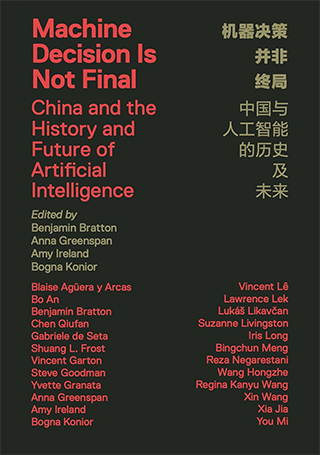
Xia Jia is the pen name of Wang Yao, a Chinese science fiction and fantasy author and lecturer of Chinese literature at Xi’an Jiaotong University. This story is excerpted from the volume “Machine Decision Is Not Final” (Urbanomic Press).