How Notting Hill Exposed Britain’s Postcolonial Crisis
In the aftermath of World War II, the collapse of empire and the rise of postcolonial and anticolonial critiques forced many self-identified British people to reevaluate their national identity and self-worth. Among the conservative right in particular, the postwar period spurred a retreat into racial exclusion, as expressed by fascist Oswald Mosley’s then-popular slogan, “Keep Britain White” — the spirit of which has resurged in U.K. politics today.
Few places in Britain revealed such tensions more starkly than Notting Hill, a central London district home to many Caribbean migrants, and ultimately, the site of spectacular racist white violence in 1958–1959. The era’s collective memory owes much to the work of English photographer Roger Mayne (1929–2014), whose photos captured the neighborhood’s charged atmosphere, and to the analysis of the Black cultural theorist and teacher Stuart Hall (1932-2014).
For white politicians and social scientists, Notting Hill demonstrated the impossibility of a multicultural community. From an anticolonial perspective, community was a goal to be achieved in the future, even as the present remained structurally and systematically divided.
Hall responded to this discourse as a teacher, activist, and editor of “Universities and Left Review.” When the racist violence broke out in ’58, he was teaching “right at the bottom of the pile” in Kennington, South London. He followed some of his white students to Notting Hill after school. He wanted to witness what they described as “a bit of argy-bargy,” meaning low-intensity street violence. He watched them on street corners, shouting abuse at Black women walking home, in chorus with older white men sitting inside pubs. Back in school, he asked them why, and the response was, “They’re taking our women” — this from 14-year-olds — or “They’re taking our things.” When Hall, who was Jamaican, asked if this “they” included himself or the Black children in the class, they denied it. He felt that violence among the young was “not willful callousness, but a part of their predicament. It is a successful surrogate, a release — for the [f]ew.” All that school had really taught them was prejudice that found a socially sanctioned release in “Notting Hill.”
To Hall, Notting Hill wasn’t just one isolated “zone” within a largely stable metropolis; it was London. The entire city was in transition. And the prejudices and violence among the self-identified white population were, even more broadly, “the unmistakable profile of Britain’s colonial policy over the last century.”
What Hall also recognized about Notting Hill was that the teenagers (a term then used to refer to people aged 12–25) marauding its streets were all shaped in the postwar period. They had grown up in a climate of conformity, overweening bureaucracy, anti-intellectual education, and repetitive jobs. Their only outlet was what he called “mass entertainment” and consumerism on the U.S. model, much to their elders’ disdain. Hall understood that culture (broadly defined) would play a key role, one absent from standard left analysis of the economy. As a former Henry James scholar, Hall had tried, without much success, to interest his students at school in Shakespeare. His writing shows detailed awareness of trends in fashion, music, slang, and what would come to be called subcultures among teenagers. After Notting Hill, Hall argued that it was the absence of a “common culture” that prevented the possibility of a democracy worth the name.
As editor of “Universities and Left Review,” Hall explored Notting Hill with the help of photographs and writings by his friend Roger Mayne. Originally a chemist, Mayne had had some initial success as a photographer in the mode of Henri Cartier-Bresson’s project to capture the “decisive moment.” Now something of a photographic cliché, this idea was new in England at the time. Indeed, the Victoria and Albert Museum responded to his request that it collect photography by dismissing it as “a mechanical process into which the artist does not enter.” Mayne’s work focused on capturing decisive moments in modern British life. He already had work in the Museum of Modern Art’s collection, and in 1956 had an exhibit at none other than the Institute of Contemporary Arts in London.
That same year, Mayne began a six-year project photographing Southam Street in Notting Hill, one of the area’s most impoverished streets. The once-elegant townhouses on Southam Street were dilapidated and run-down by 1956. Subdivided into multiple flats with just cold water and toilets only available communally on landings, these properties were rented to the urban dispossessed, including single parents, Irish people, and Caribbean migrants. Violence was part and parcel of life. (It was on the corner of Southam Street that Kelso Cochrane, a 39-year-old Antiguan carpenter, was murdered in a racially motivated attack, and a year later, where Mosley held a rally for his fascist Union Movement on the same spot.) Nonetheless, Mayne found a dynamism there that contrasted with the apathy of postwar Britain:
My reason for photographing the poor streets is that I love them, and the life on them. . . . Empty, the streets have their own kind of beauty, a kind of decaying splendour, and always great atmosphere — whether romantic, on a hazy winter day, or listless when the summer is hot; sometimes it is forbidding; or it may be warm and friendly on a sunny spring weekend when the street is swarming with children playing, and adults walking through or standing gossiping. I remember my excitement when I turned a corner into Southam Street, a street I have since returned to again and again.
Mayne’s photographs captured moments of street life that were unusually active because cars were banned from Southam Street as a “play street,” making it into an informal playground and youth center. Mayne lived locally in a classic two-up, two-down terraced house, which he had, in his own words, “‘modernised’ by the division of a first-floor room into kitchen and bathroom, and I had the two top-floor rooms knocked into one.” Mayne, too, was part of the transition — as a gentrifier.
He moved there because he considered himself an artist, and Notting Hill was an artists’ area. Painter Lucian Freud, grandson of the psychoanalyst, had a flat on Delamere Terrace, just a mile from Southam Street. The street faced the Regent’s Canal, and as Freud put it, “Delamere was extreme and I was conscious of this. A completely nonresidential area with violent neighbors. There was a sort of anarchic element of no one working for anyone.” He painted a young local man named Charlie Lumley in 1950–1951. Titled “Boy Smoking,” the small painting has a close focus on Lumley’s face, dominated by his blue eyes and full lips. Although he’s said to be smoking, his cigarette has gone out. Lumley’s look directly engages the artist/viewer with an affect that is at once vacant and queer. Freud used Lumley as an optic into working-class life, remarking, “Sometimes things that I didn’t understand Charlie would explain to me: the harsh ways and laws of the life [in Paddington], such as the things people were respected and despised for.”
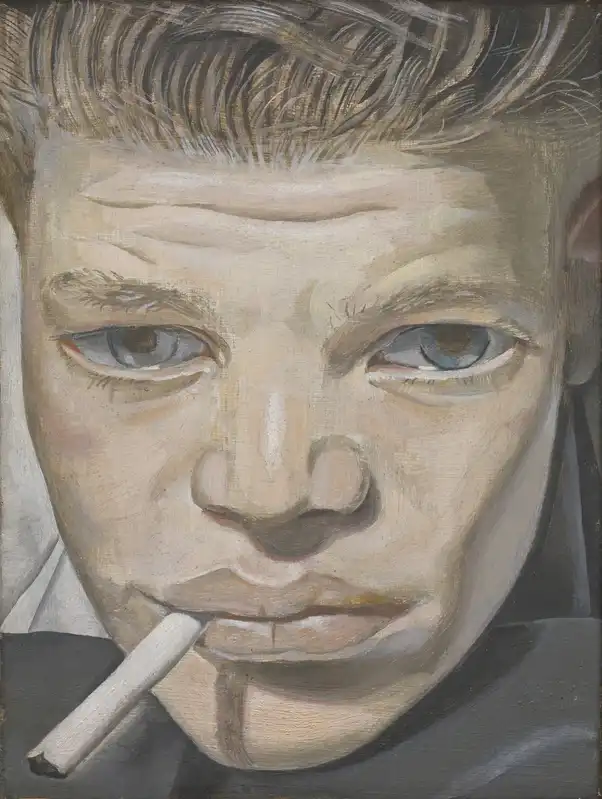
Unusually for Freud, the frame cuts into the boy’s head. Mayne appropriated both Freud’s subject matter of underclass London and his compositional technique. Mayne’s own photographs similarly let the frame cut through people or events. His focus is sometimes a little off, and his depth of field is sometimes forced. It is the uncertain dynamic of class and ethnic relations that gives his photographs their energy. Despite many formal differences between Freud and Mayne, they shared a common concern with how humans might connect and communicate across class, gender, and racial divides in the postwar, decolonial moment.
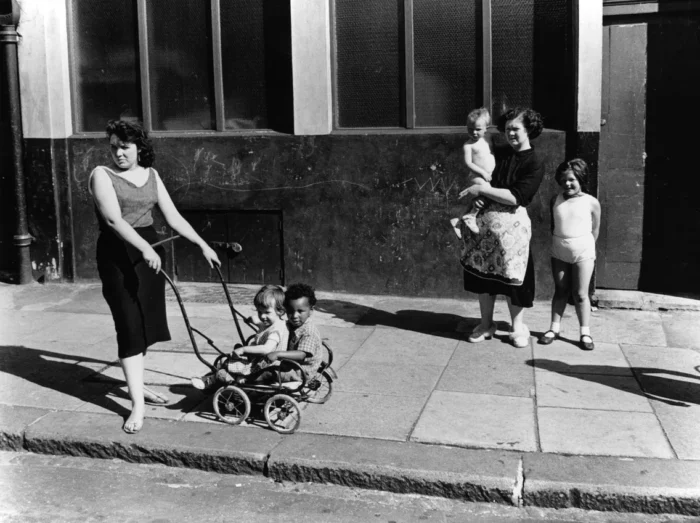
Mayne’s Notting Hill photographs depict predominantly white-appearing teenagers, mothers, and children, but few adult men. A minority of Caribbean people of all ages were mixed unevenly among them. Some recent commentaries have sought to interpret Mayne’s work as addressing class to the extent that it even “transcends race.” To the contrary, Mayne’s photographs perhaps unwittingly illuminate Hall’s signature insight, derived from his own experience as a migrant: “Race is the modality in which class is lived. It is also the medium in which class relations are experienced.” None of the invented traditions of working-class belonging can be seen here — flat caps, football support, going to pubs, and the labor movement — except for the respectably dressed young children, who are nevertheless out on the street.
In the transitional time-space of Notting Hill, English, Scottish, and Welsh working-class people came to see themselves first and foremost as “white,” or more precisely, to be British was to be white. Their Caribbean counterparts came to understand, as Hall himself had done, that they were seen first and foremost as “Black,” a category that made any claim on Britishness partial at best in white eyes.
Notting Hill wasn’t just one isolated “zone” within a largely stable metropolis. The entire city was in transition.
In a 1956 photograph, Mayne recorded four smartly dressed West Indian men walking down Southam Street. The landscape format of the picture evoked what he called the “atmosphere” and “beauty” of this urban space from which the eye has no exit; even the windows are impenetrable, thanks to thick net curtains. The even grayness of Mayne’s work unconsciously records the permanent London smog of those coal-fired days. The men pass among four visibly white boys, each of whom is staring fixedly at them, as if in illustration of Frantz Fanon’s “Look! A Negro” scene. None of the men pays them any attention. One looks over at the photographer, his glance mingling caution and good humor.
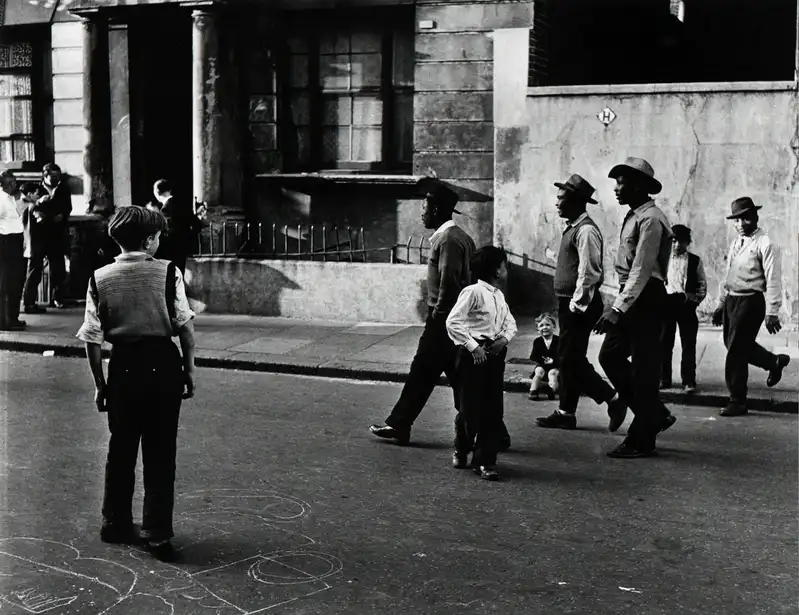
Labor politician Alan Johnson grew up on Southam Street, and in his childhood memoir, he observed how the men in Mayne’s photograph are “on the look-out for trouble as they head towards a group of young guys gathered around the steps leading up to a front door. Youths with grey pinched faces who don’t yet seem to have noticed the quartet ambling towards them.” Looking was confrontational, as Johnson described: “When to look, when not to look and indeed how to look was a complex skill, acquired through trial and error. It was important to appear ‘hard.’” If the youths on the stoop were to meet the look of the walking men, they would then be required to challenge them: “Oi ‘Oo you screwin’?” where “screwing” means to look.
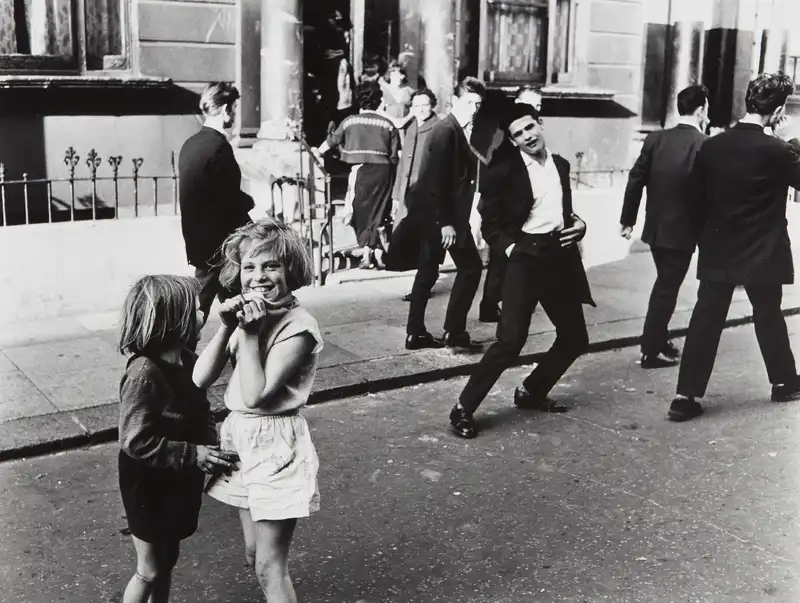
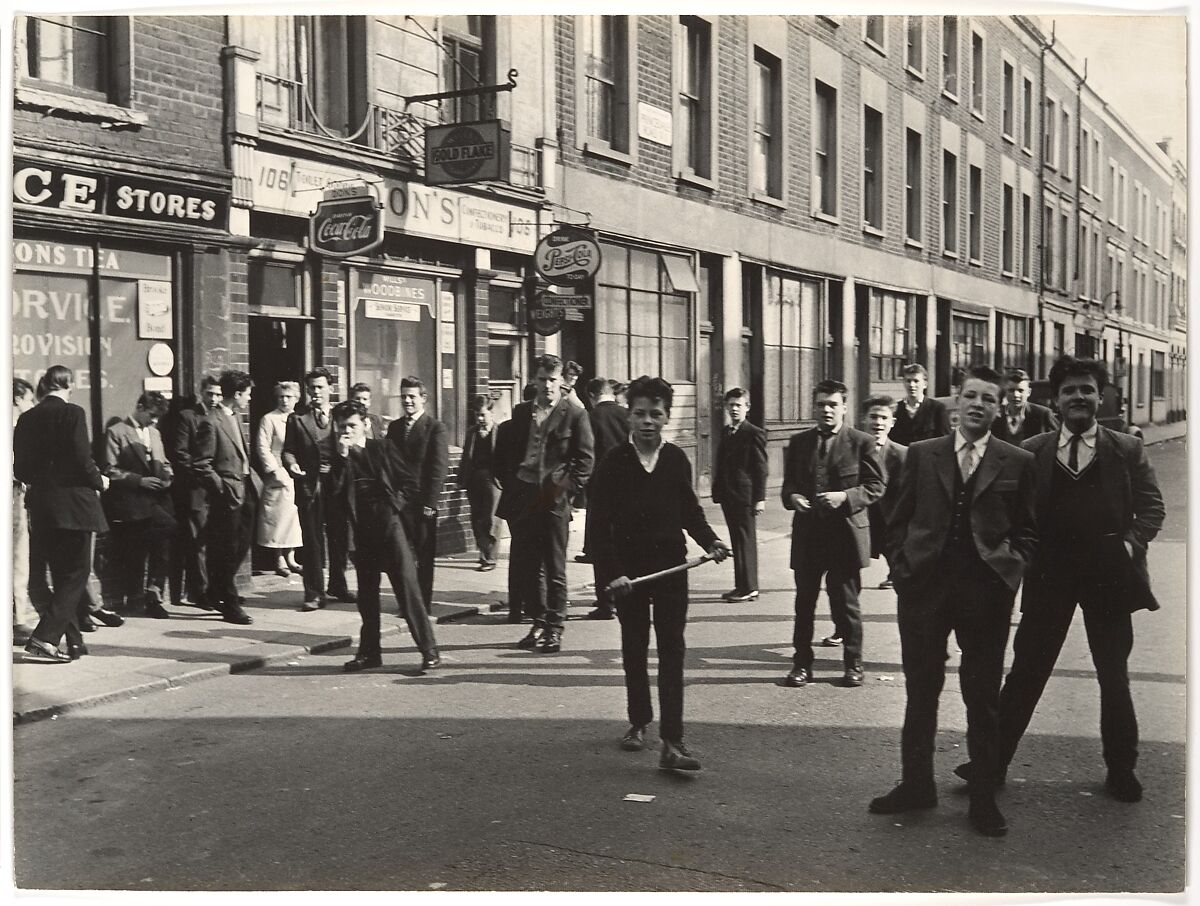
In 1959, Stuart Hall assessed that support for Oswald Mosley — who led Britain’s fascist Union Movement, which was virulently anti-immigrant — “is far higher than the voting figures suggest.” Indeed, the masculine fascination with fascism, to borrow from Susan Sontag, went much further than the ballot box, as our own time has sadly borne out. Accordingly, the street became a place of danger when men performed racialized masculinity in it. Consider Mayne’s photograph of a line of Teds (or Teddy Boys, a white subculture that wore dark jackets, white shirts, and crepe-soled shoes) blocking off Southam Street. As one of them gestures at the camera with a long stick, this potential violence becomes visible. Jewish East End poet Emanuel Litvinoff remembered similar tactics in the 1930s when he and a friend ventured into neighboring Hoxton, hoping to impress local young women: “Instead of attracting female attention, we ran into a gang of youths who spread themselves across the pavement, and told us to get back to Palestine.”
This informal color bar was reinforced by the police, occasionally seen in Mayne’s photographs. The police, then and now, were reluctant to get involved in “domestics,” meaning violence or abuse within the home. What can’t be seen in Mayne’s photographs is the “drunk and violent” behavior of white men in their flats toward women and children. Mayne believed it was “unhappiness, loneliness and lack of human contact that characterises the English.” This unhappiness was registered obliquely in terms of sexuality, as he referred to the landmark 1957 British government report that had recommended decriminalizing male homosexuality and prostitution. A new morality would require what Mayne termed an acceptance of “the less normal but inevitable sides to sexual behavior.”
These dynamics were directly addressed in Colin MacInnes’s 1959 novel about Notting Hill, “Absolute Beginners.” At first, “Absolute Beginners” has no foreboding to speak of, instead depicting a fast-moving youth culture, where drug use and a range of sexual expression were common. It narrates the life of migrants, subcultures, media professionals, and part-timers (a key source of revenue for many migrant writers), and the new “teenagers” in a postwar London, then as now, clinging to delusions of imperial grandeur. The anonymous teenager who narrates is a photographer, Jewish by descent through his mother. He has Jewish friends and observes that if the Jews were to leave London, so would he. His photographic work is commercial, mostly fashion and some TV, but backed up by a lucrative line in pornography. The photographer really wants to be an artist, like Mayne, Freud, or many other Notting Hill bohemians. His friends include Big Jill, a lesbian organizer of sex work; Mr. Cool, a “mixed-race” teenager; and Hoplite, a queer media personality and party organizer.
In short, this was not the standard character group in the 1950s English literary novel. In search of becoming an artist, the narrator nonetheless poses young models in scenes said to evoke Englishness, such as on a rowing boat.
Suddenly, the writing takes on an altogether different tone, and the narrator tries to explain it. Referring to Notting Hill as “Napoli,” which translates in English to Naples, he writes: “You could feel a hole: as if some kind of life were draining out of it, leaving a sort of vacuum in the streets and terraces. And what made it somehow worse was that, as you looked around, you could see the people hadn’t yet noticed the alteration, even though it was so startling to you.” In the end, “Absolute Beginners” is rightly remembered for its concluding depiction of the violence in Notting Hill.
In the transitional time-space of Notting Hill, to be British was to be white.
In Notting Hill, as MacInnes imagined it, the Jewish photographer, seeing white violence directed at Caribbean residents, can no longer sustain the illusion that Notting Hill enabled a “disjointed form of communal sociality.” The racist violence opened a hole in white reality. What happened to Black people in Notting Hill allowed the narrator to see how he was perceived and to feel the “alteration” that had always been there from their perspective. This tear in white reality was shocking and “startling,” for white people at least.
Seen from the radical perspectives of the 1960s and 1970s, this rupture in whiteness would have seemed like a small harbinger of what was to come. Then again, the resurgence of white racism from Margaret Thatcher to Brexit and its now-routine expression on social media suggests that the reaction, at first slow in the making, has been more and more forceful. As Hall observed, “Empires come and go. But the imagery of the British Empire seems destined to go on forever. The imperial flag has been hauled down in a hundred different corners of the globe. But it is still flying in the collective unconscious.”
Nicholas Mirzoeff is a professor and the chair of New York University’s Department of Media, Culture, and Communication. His writing has appeared in the Guardian, the New York Times, Hyperallergic, and the Los Angeles Review of Books. He is also the author of many books, including “How to See the World,” “The Right to Look,” and “White Sight,” from which this article is adapted.