A Brief History of the Internet’s Favorite Scam
A message arrives: a panicked plea referencing a desperate situation in an exotic location. It might be a wealthy refugee family trying to make it out of Zimbabwe, or the widow of an aide to Saddam Hussein in a hospital in Chiang Rai, or a Russian oligarch’s daughter hiding in the Czech Republic and communicating through her London solicitor.
They are looking for a compassionate soul — “whom God will use to assist me and my family” — who can help them get themselves and their assets — “US$45,000,000.00” — out of this difficult moment in geography and history. The phone and fax numbers work, and the web addresses point to real news sites — “You can go to google in internet and check my clients name and information” — and many of the government bureaus and banks check out online.
This is what’s known simply as the advance-fee fraud, or the 419 scam. It is so unmistakable that it embodies its own parodic genre, casually appearing as a gag in television comedies like “30 Rock” and “The Office.” It always starts with the same canonical line, trotted out in conversation over the phone, or perhaps over email: “Hello! I am a Nigerian prince.”
It is easy to see 419 merely as a tired cliché — and to mistake that familiarity for understanding. But doing so often leads to facile assumptions about the risks, motives, and imagined rewards on both sides of the exchange. To see the scam clearly, we need to treat it not simply as spam, but as a cultural myth, or even a motif. These scams are not ads for products — for porn or mortgages or relief for masculine anxiety. They are part of an enormous web of narratives, running back centuries, about corruption, politics, and the failures of globalization, from which you, the reader, can allegedly profit.
Advance-fee fraud dates back to at least the 19th century, with the emergence of the Spanish Prisoner confidence trick. It goes like this: There is a beautiful, rich woman incarcerated by the cruel King of Spain for complex political reasons. You have been contacted because you could help her escape. In return, she will give you a portion of her fortune (and possibly more). The escape is complex: There need to be bribes for the guards, hired guides, supplies for the trek through the mountains, and help for the inside man. You receive pleading notes from her and letters of credit that will make you wealthy once she and her assets have been reunited.
You choose to assist. However, things do not go smoothly because Spain is a far-off foreign country in turmoil, politically confusing, and corrupt. Perhaps there’s a change of authorities and a new set of bribes is needed; the muleteers have to be paid off. Or maybe negotiations have broken down, or the prisoner has fallen desperately ill and needs a doctor, which the prison won’t provide — but you can help.
It is a persistent con, changing to suit the times and political circumstances. Arthur Train employed it in his aptly titled 1910 short story “The Spanish Prisoner,” which features a small-time American gambler who was duped by a fraudulent letter from Spain, enclosed with a newspaper clipping of real news events. The letter’s author — who claims to be a wealthy man from the Canary Islands — says he is imprisoned in Madrid and needs help recovering a fortune, of which the protagonist would get a cut:
MADRID, 7th I—, 19—.
Gentleman: Arrested by bankruptcy I beg your aid in the recovering of a trunk containing two hundred and fifty thousand dollars deposited at an English station, being necessary to come to Spain to leave free the seizure of my baggage, paying the Tribunal some expenses in order to take to your charge a valise . . .
Let’s step back to consider all the different levels of literary performance at work here. Geographically, the 419 plays on the remoteness and romance of a location, a pliable, vague background for tropes from fairy tales and popular thrillers, such as beautiful, unjustly imprisoned aristocrats and daring rescues. Temporally, it draws strength from current events, particularly war and political chaos — situations in which it is plausible to imagine unlikely fortunes and desperate bargains. It also has great narrative pull and traffics in compelling details and convincing documents, from that Spanish newspaper clipping in Train’s story to the JPEGs of gold bars and the faxes on UN letterhead today.
While all advance-fee scams share the same narrative contours, they have, over the centuries, been seamlessly retrofitted to the technological platforms and practices of spam. From letters and telegrams in a world of newspapers to email messages in a 24-hour news cycle, 419 works where the spammer’s capacity to generate evidence exceeds our individual capacity to evaluate it — given some willful suspension of disbelief.
Not too much suspension is required, though, for reasons anthropologist Daniel Jordan Smith has described. After all, the structure of 419 messages is predicated on a general understanding of how a profoundly corrupt society operates. This is apparent to both the sender and the receiver.
These scams are part of an enormous web of narratives, running back centuries, about corruption, politics, and the failures of globalization.
From the perspective of the senders, working in internet cafés at 70 cents an hour (or $2 for a full night’s use), the messages are a natural enough business practice in a society that is, in fact, profoundly corrupt. It is common knowledge among them that the country’s elites do actually move millions, and even billions, of dollars out of the country covertly, in collusion with Western business partners and banks; there are plenty of African industrialists and dictators who cut deals with people overseas to send money abroad in return for a kickback. Furthermore, the countries these elites run are so thoroughly corrupt that any significant advancement — any construction of a building, resource extraction project, even getting a phone line or a lease — involves some palm-greasing and “additional costs.” If that’s the case, how do you expect to make any real money without following their lead?
On the recipient’s side, it takes a deeply cynical (if ill-informed) understanding of politics — not necessarily Nigerian, as the messages are often set in other presumably chaotic and corrupt environments — that views the world as including these covert machinations from which you are finally in a position to profit. This cynicism is combined with an almost touching naïveté on the part of the Westerners responding to these messages: Not only are they taking it for granted that someone would actually work with them to smuggle millions in gold or launder some huge sum in dollars, but they are also laboring under the assumption that their sudden windfall would not attract the attention of Interpol, the Economic and Financial Crimes Commission, the IRS, or the FBI.
All told, this strange dynamic between sender and receiver in 419 messages contains a perverse kind of brilliance: They turn the very fact of Nigeria’s history of exploitation by Western interests and its own leadership into a resource that can itself be exploited — as a place in which outsiders can be convinced that they, too, can take advantage and make a fortune.
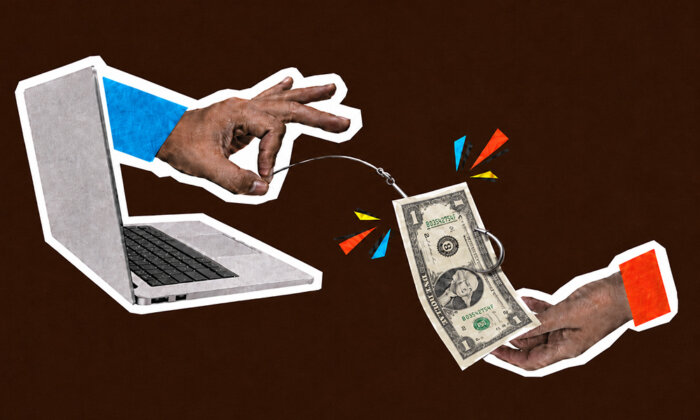
But who is actually doing the exploiting? Not the writers of the messages themselves; they are merely fishing for marks, who are then passed up the chain to a smaller group of bosses. Rather, it is the kind of people with the resources and expertise to procure fax messages, letters, credit cards, time-stamped photos of gold bars, and so on. As Smith — who has lived in Nigeria for a number of years and is married to an Igbo spouse — quotes a young 419 writer he interviewed: “The people getting rich from this are the same people at the top who are stealing our money. I am just a struggle-man.”
These low-level, somewhat educated scammers, like the one Smith interviewed, live in a society largely bereft of opportunity for those without connections by birth or patronage. They have ended up as components in a strange kind of writing machine. This machine is made up of young people and old computers telling and retelling stories from templates circulated by email and thumb drives, with names changed and details updated with fresh material from the news: U.S. soldiers have found a cache of Saddam Hussein’s gold; a natural-gas oligarch needs to spirit his money out of Vladimir Putin’s Russia. Meanwhile, the higher-level bosses — with their stolen or manufactured stationery from Nigeria’s U.S. embassy, NGO offices, and central banks, and the money to arrange settings for plausible overseas meetings — are drawn from the ranks of white-collar professionals such as attorneys, accountants, and engineers.
They turn the very fact of Nigeria’s history of exploitation by Western interests into a resource that can itself be exploited.
Jenna Burrell’s ethnographic work among internet scammers in Accra, Ghana, captures a somewhat similar dynamic of exploiting a legacy of exploitation in a quite different West African context. Her research places the work of advance-fee fraud messages as a subset of the larger project of establishing overseas relationships online for many different purposes — especially the essentially benign and enormously popular Ghanaian practice of collecting “pen pals.”
The writers, Burrell found, are obliged to create stories that model the stereotypes of their region that they think a Western audience already believes, in an operationalized form of W. E. B. Du Bois’s “double consciousness” — the obligation to see oneself through the racially charged and stereotyped perceptions of others. Often, this employs the vague and ignorant sense of Africa as a largely continuous and uniform environment of poverty, war, resource exploitation, and corruption. “You know the situation in Africa,” Burell quotes one of her interviewees, describing his framing of a begging letter. Whether seeking pity or manipulable greed, the writers know they will have better luck with a tale of wartime orphanhood and AIDS than with trying to raise funds to start a business, take IT classes, or move into one’s own apartment, which may, in fact, be the case.
Of course, this tactic further reinforces existing stereotypes of Africa generally, both by adding to their retelling and by producing a more general fear of scams, confidence tricks, and corruption.
The advance-fee fraud strategy was based on a large volume of messages long before it became digital. In the 1980s, after the financial collapse of Nigeria’s oil bubble, the scam first became popular as a paper-based business in a complex culture of criminal practices involving counterfeit postage and forged letterheads. When U.S. postal officials cracked down on mailings in 1998, they seized 2.3 million letters arriving at JFK Airport over three months.
Though technically quite unlike spam, this wave of postal fraud operated on similar economics: The cost of mailing was kept artificially low through counterfeiting, and the profit from a successful message far outweighed the production costs. Like phishing and related identity-theft activities, a successful 419 message could pay out anywhere from hundreds of dollars, pounds, or euros to hundreds of thousands. With that irregular rate of return and low overhead, there was no reason not to cast a net as wide as possible.
It is difficult to obtain estimates of replies to 419 messages because few victims report successful scams. (Bear in mind that they involve both the shame of gullibility and the potentially more serious consequences of the victim agreeing to engage in illegal activities.)
Periodically, however, the most catastrophic successes turn up on the public record: In 2000, a businessman named James Adler sued a long list of defendants, starting with the government of Nigeria and the country’s central bank, after having paid out $5.6 million over the course of years to participate in transferring stolen funds out of the country, with the promise that he would receive a 40 percent cut. Unsurprisingly, the court did not carry the case forward, given that Adler was suing to recover bribes and other expenses involved in defrauding the Nigerian government of $140 million of over-invoiced funds: “Adler dirtied his hands by intentionally attempting to aid and abet the Nigerian officials’ scheme to steal from the government, and by paying bribes.”
Years later, in 2003, a Czech retiree named Jiří Pasovský murdered a Nigerian secretary at the country’s Prague embassy after being told the Consul could not help him recover his losses, which amounted to around $600,000. (This event joins the grim list of 419 scams that end with suicide or murder on the part of the defrauded victim.)
“The people getting rich from this are the same people at the top who are stealing our money. I am just a struggle-man.”
And then there is the 419’s notorious Everest, starting with a scam built around the promise of an airport construction investment: From 1995 to 1997, the entirely respectable international banker Nelson Sakaguchi beggared Brazil’s Banco Noroeste, transferring $242 million in an effort to secure the deal and then to make back and conceal his enormous losses. (Misha Glenny, one of the great journalists of globalized crime, compares the scale of the disaster to Nick Leeson breaking Barings Bank and the looting of the Iraqi National Bank in 2003, to put this example into perspective.)
Thanks to these — and other — high-profile incidents of skullduggery, the international cultural impact on Nigeria has been striking. No other country has become so synonymous with spam, even though the vast bulk of the volume has come from the U.S. and (much less so) from China, Russia, the United Kingdom, and Brazil. As Smith points out, 419 messages have only added to the deep unease among outside investors toward Nigeria, reinforcing the perception of a country of thieves. Within the country, “419” has a much broader meaning, referring to general fraud, much of it directed against other Nigerians. 419 can mean the vast frauds perpetrated against the population by political and business leaders working hand in glove with foreign corporations, small-time quack medical experts, and everyday scams like selling or renting homes under false pretenses.
An entire subgenre produced by the thriving and astonishingly creative “Nollywood” — a portmanteau of Nigeria and Hollywood — industry has devoted itself to 419 videos, featuring the many travails, disasters, and moral turpitude of the scammers who prey on one another and their own people. “The Master” is a representative example: Its star, actor and comedian Nkem Owoh, wrote the song “I Go Chop Your Dollar” for the soundtrack, emphasizing the thrill of winning at 419, which is “just a game” that everybody plays (“Everybody dey play am.”).
To be sure, Owoh’s song is not an endorsement of scamming, as he himself has made clear. It is simply an illustration of the world as it is. It is a vision of a society of institutionalized corruption in which everyone — from the lowest hustler to the highest official — has been made a part of the game.
Finn Brunton is a Professor of Science and Technology Studies and Cinema and Digital Media at the University of California, Davis, and the author of “Spam: A Shadow History of the Internet,” from which this article is adapted.