Jules Verne’s Empty Dream of Spaceflight
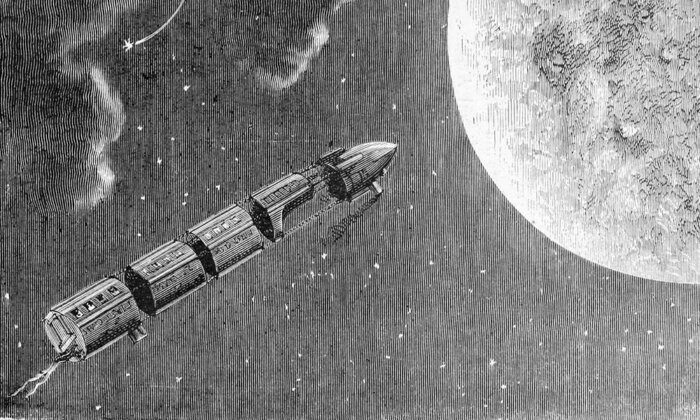
About halfway through “From the Earth to the Moon”— which is to say, still firmly on Earth— Jules Verne tells us that in a time when a 30-mile-per-hour train is considered speedy, the public finds it “natural” to launch a projectile to the moon. Granted, this is in contrast to the newer idea of putting a person inside that projectile, but even that, a few pages later, is described as something that would happen “sooner or later.”
Natural is an interesting word to describe an endeavor that requires digging an enormous hole on a hill in uncultivated land in Florida, mining and melting a bunch of aluminum, and pouring it in — not to mention then setting a formal table to eat a multicourse meal at the bottom of it. But leaving that implication of human depredations aside for the moment, the suggestion of inevitability — the “because it’s there” school of lunar landings — also serves as a reminder that no one has really given any reason for launching this incredible enterprise. Over the course of 200 pages, describing extreme efforts of engineering, mining, astronomy, and fundraising, no clear rationale is given for traveling to the moon.
In the book, Impey Barbicane, the redoubtable ballistics expert who comes up with the idea, asks, “What for?” about decorating the capsule’s exterior, demonstrating how rational and unartistic he is. That is, in contrast to the more emotional, romantic Michel Ardan. But he never asks the same question about the voyage itself. In his inspiring oration, which ignites national and eventually global enthusiasm for the endeavor, he says only that no one has done it before, that despite all the accumulated knowledge about the moon, “no one has ever established direct communication with her,” a statement that provokes “involuntary expressions of surprise.” The embodiment of rationalism is seemingly conducting a major endeavor without a reason. In fact, however, the reason is already implied in his statement, so obvious to everyone that he doesn’t need to say anything more. For him and for his listeners, the possibility of doing it and doing it first is enough.
Ardan may be offered as a contrasting character to Barbicane, but when he arrives to announce his intention of traveling to the moon and staying there indefinitely, he similarly says only, “I have a chance to take a trip to the moon, and I’m taking it, and that’s all there is to it.”
In Verne’s world, science — or perhaps exploration, since no scientific goal is explicitly mentioned for this project, or perhaps even simply achievement, since the initial proposal does not include any riders — is a self-evident good. Or maybe, rather than good or bad, it is simply inevitable. In his public speech, Ardan offers a version of technological inevitability in its earlier expression as “the law of progress”: “Man started to travel on all fours, then one fine day, on two feet, then in a cart, then in a wagon, then in a stage-coach, then in a railroad car, and now! The projectile is the vehicle of the future.”
In my world — that is, sociology, political science, and literary criticism — the things that are assumed to be self-evident or inevitable are usually the ones that are the most rewarding to unpack. In the case of the Gun Club, the group leading the moonshot scheme, the team’s implied attitude also offers an interestingly warped reflection of our own ideas about science.
Much of science as we conceptualize it now was built on top of the framings of Verne’s era. Revisiting the exuberance, obliviousness, chauvinism, and optimism of Verne’s science-related worldview offers a useful reminder of where some of our own narratives come from.
For all their lack of explicit calls to action, the various people involved in the scheme of sending a bullet to the moon have apparent motivations. The closest thing to a rationale that Barbicane offers in his speech is that this enormous effort of science and engineering, labor and calculation, will fill the void left by the end of the U.S. Civil War. Yes, Verne’s Gun Club, full of artillery fanatics, is a cartoonish satire of U.S. stereotypes that today plays more as horrifying than as comedic. But there’s a serious idea underneath: that science — perhaps in particular the competitive, high-risk sort of science exemplified in the book — can channel human energies into something more productive and peaceful (if still explosive).
This idea still has currency today, even if it’s usually framed a bit differently: Rather than seeing science as a replacement for war, we tend to talk about the power of international collaboration, building linkages and understandings that will prevent war. It’s a more positive version of the Watchmen’s common-enemy doctrine — if we’re working together against disease or for space exploration, then we won’t fight each other.
There’s an alternate view, however: that the project Verne describes replaces war in another, less positive way. Imperialist, egoistical, both reckless and heedless, Verne’s vision of scientific endeavor is war by other means. It is a way of accumulating territory and resources without (necessarily) having to fight for them. Barbicane makes this connection explicit in his oration, comparing himself and his fellows to Columbus and claiming that he will lead them “to conquer that world, its name will be added to those of the thirty-six other states that already belong to the Union!” Similarly, discovery or achievement offers a supposed proof of superiority apart from force of arms, much as the moon landing and space race formed another front in ideological and national conflict during the Cold War.
Verne gives his story an international varnish, with funding and scientific contributions from across Europe, Latin America, and parts of Asia, if not quite from all over the world. But he also repeatedly emphasizes the supposed national character of the Americans that allows them to conceive, execute, and lead the effort: “the inventive genius of the Americans”; “the practical genius of the American”; “the daring American genius,” and so on. It’s the same belief in inherent superiority that was/is used to justify colonialism, given a pretense of rationality rather than religion, that does not change its fundamental violence. According to this belief, if science or engineering is a pure and noble purpose, an end in and of itself, then that can be used to justify both its own direct depredations and a position of privilege for those who enact it.
Imperialist, egoistical, both reckless and heedless, Verne’s vision of scientific endeavor is war by other means.
The Gun Club needs another use for its hobby, not just because of the lack of war; the novel makes it clear that the war has also triggered significant innovations and improvements. The deliberations of the Gun Club, in fact, suggest a disturbingly linear conception of artillery development: If a cannon of this size shoots a ball this far, then doubling the distance is constrained only by the resources to make a larger cannon. This scaling implies an idealized, theoretical conception of engineering; it also pretends a possibility of limitlessness, one that is echoed in the projections or demands for exponential growth and development favored in modern technological rhetoric.
Verne does present the material and calculation obstacles to his characters’ endeavor, but each problem is promptly solved, giving readers the sense that for any technical problems the characters might encounter, the solution is simply a matter of some invention or discovery that has just been made somewhere in Europe or the United States — and if it hasn’t been, it will be soon. You can almost feel Verne encouraging young potential scientists to keep trying. It’s a heartening, exciting view of science, to be sure, a sparkling and largely unmapped conceptual world with discoveries possible in every nook.
But, again, Verne’s book is less concerned with discoveries than with action and achievement. The technological optimism extends to the point of no test flights and figuring out whether chemical oxygen production will work simply by locking someone in the capsule. Verne builds his protagonists into worship-worthy heroes in part by emphasizing the dangers they willingly undergo in the name of discovery (or science or achievement). Even when technology — or perhaps human calculation — is not completely successful (fails) at the end of the novel, Verne still offers the firm belief that the passengers will engineer their way out of orbit: “Those three have taken with them, out into space, all the resources of art, of science, and of industry. With such resources, they can accomplish anything; you wait and see, they will resolve this situation soon!”
This attitude also resonates in our very different context today, when we continue to tell ourselves stories about new technologies that will save the planet without requiring us to change how we live. Technology myths have generated an entire genre of gushing news articles about how the breakthrough to “solving” climate change is right around the temporal corner. There is certainly enough unknown left in the universe to tap into the same sense of possibility that Verne invokes, but often, as in the book, the unknown is presented as the means to an end — glorious derring-do for Verne’s characters, usually profit today — rather than a wonder in and of itself.
“From the Earth to the Moon” describes an exuberant age of exploration, when, at least in Verne’s view, there was no concern about ethical implications, environmental damage, or justification for the excessive use of resources. The characters don’t justify their immense efforts to reach the moon with any specific scientific questions (indeed, the uncrewed mission would have offered very little scientific information, which is something of a shock in our remote-data age) because doing something that has never been done is justification enough. Finding a way to do something never done before becomes evidence, as Verne reminds us again and again, that humans can engineer their way through the greatest challenges.
Given the stereotyping of nationalities so pervasive in Verne’s writing, it’s not surprising that this belief translates into exploration for the greater glory of the patria. Among Verne’s broad knowledge of science and the prescient details of future spaceflight — the launch from Florida, for example — I found most striking his premonition of a voyage to the moon driven by the obsession with planting the United States flag. This foresight is a little odd in its isolation because while Verne has a fair amount to say about the U.S., the main characters don’t talk much about their country, and the flag isn’t mentioned in the preparations for the capsule. As with the determination to continue expanding the possibilities of human endeavor that underpins the entire drama, identification with nationalism is such a given for the characters that it is barely mentioned.
Before the real moon landing in 1969, it could have gone unnoticed. But now, there is a throughline from a foreigner’s part-caricature imaginings of a country in the 1860s to a defining image of scientific achievement as nationalist competition in the 1960s. The key difference is that while the real moon landing was very explicitly and strategically a government project, Verne’s is thoroughly not. It is both private and, in the noninstitutional sense, public, internationally funded despite being led by Americans.
Finding a way to do something never done before becomes evidence, as Verne reminds us, that humans can engineer their way through the greatest challenges.
Indeed, if the story is a little vague on what science is for, it is even more conflicted on who science is for. In another of his observations on the “American [sic]” psyche, Verne comments that “[Americans] show more concern for humanity in general than for individuals in particular,” but Barbicane “professed contrary principles” — proving the rule, perhaps. (This is, it should be noted, in a passage about how it was “inevitable” that some workers would be killed during the dangerous work required to realize Barbicane’s vision; Verne writes about Barbicane’s care, intelligence, and intervention to solve difficult cases but never describes him as joining in the work himself.)
The story oscillates between the masses and individuals, between science as a massive public endeavor — not only national but global — and science as the province of a tiny number of men (a common trope for Verne, who excelled at creating characters for children to admire). The idea for the voyage to the moon comes from Barbicane, but it is almost instantly transmitted to the nation and the world, going viral at a speed that would seem extraordinary even for a communication from the president of the country, much less from the president of a gun club. There is a sense of the idea scattering in all directions as the listeners rush out into the streets and telegrams carry the story across the continent. The voyage to the moon becomes a cause célèbre, a megatrend, something that the entire country is deeply engaged with.
In the wonderfully titled chapter “What It Is Impossible Not to Know and What It Is No Longer Permissible to Believe in the United States,” Verne shows how this kind of national obsession can lead to a new sort of collective framework of knowledge — much the way a news event will lead to a sudden algae bloom of pseudo-experts on social media. Suddenly, there is a whole new set of facts — “facts” that are not just common but required knowledge, enforced by peer pressure. It’s a wonderful scenario of an ambitious project as successful science communication, the glamor and exhilaration making the technical details not only cool but also important to wide swathes of people.
Although the national passion for the moonshot seems to lend energy to the project, when it comes to planning the actual details of the endeavor, a committee is formed to discuss the major questions. Astonishingly, the “committee” includes only four people; more astonishingly, they are the same four people for each of the topics; and while the other three eat large numbers of sandwiches and drink gallons of tea, make reactive noises, and occasionally put forward opinions, virtually every decision that is adopted is proposed in fully elaborated form by one person: Barbicane himself. Out of an entire country of enthusiastic potential participants, he is presented as the apogee of abilities in almost every knowledge area, with the exception of the astronomical calculations conducted by the Cambridge Observatory and the production of the physical elements, but even that is carried out to his specifications.
Even if one accepts a narrative demand for fewer named characters, not giving any expertise to the already existing named members of the Gun Club is a choice. It reflects a story structure that depicts all-but-perfect, wide-ranging, sole heroes with a collection of admirers; compare, for example, the more recent trend of many disparate characters with complementary skills and abilities united under one leader. In science, as in disaster response and politics, we still fall prey to the effects of the lone genius/hero/visionary paradigm.
Several scenes in this book reminded me of that uncomfortable moment in “Twenty Thousand Leagues Under the Sea” (1869–1870) when the sailor and the servant tell the savant that they have saved his life at the risk of their own because his life is worth more than theirs. This is another moral risk to the kind of exploration Verne describes: Valuing science as an end in itself not only leads to the heedless destruction of resources in its name but also gives those who do science a status as more valuable than others.
Valuing science as an end in itself not only leads to the destruction of resources but also gives scientists a status as more valuable than others.
Barbicane also has the crucial plan for financing the project: old-school crowdfunding. It is public in the most direct sense: There is almost no mention of the government; the money comes from the people themselves. And, unlike in a Kickstarter campaign, the contributors explicitly get nothing in return. Science, it seems, has value for the masses even when they have no direct benefit from or connection to it.
Tens of thousands of people chip in to build this enormous cannon to launch a projectile to the moon. One man directs the entire project. And then, when another man, out of nowhere (France), announces that he is going to travel in that projectile, he takes control of the moonshot without the slightest investment of venture capital or effort. Barbicane asks Ardan if there’s any way he can dissuade him from going, as if he couldn’t simply refuse him passage.
Narratively, this is a way to handwave away the responsibility for a character taking enormous risks, but it also points to the lack of leadership, ownership, or decision-making authority. There is no organigram. The capsule belongs not only to everyone but also mostly or even only to the person (man) who evinces the most ingenuity and authority. It could be argued that Ardan, in his heedless celebrity, also belongs to everyone; he is the embodiment of the trend of risk-taking exploration. It’s easy to imagine now the kind of pseudo-documentary drama that would be made about these characters in today’s world: Ardan the charismatic leader, Barbicane the cold scientist, possibly with resentment smoldering behind his eyes.
At the end of the book, Verne returns to the masses, describing in loving variety and detail the crowds who gather to see the launch — “all the peoples of the Earth were represented there; every language could be heard at the same time.” There is something bittersweet in the way Verne so vividly imagined the ecstatic mood of an event he wouldn’t live to see and shared that imagining with generations of readers who wouldn’t see it, either. This, it seems to me, is a practical justification for science fiction: to share a potential experience across time, just as a newspaper description of an event shares an attenuated sense of an occasion with those excluded by distance.
Earlier, in one of the moments of pure science in the project, far from the driving personalities of the construction site, the most powerful telescope yet available is installed on a mountain. That process is described only briefly and as a miniature version of the main plot: It is incredibly difficult, involving a multitude of dramatic natural challenges (enormous rocks, desert prairies, impenetrable forests, rapids, and so on), “but the American genius overcame a thousand such obstacles.” None of our heroes is there; the people who build the telescope and look through it aren’t even named, being referred to only as “observers.”
Unlike, for example, Ardan, who doesn’t lose a bit of sleep before being shut into a capsule on top of a massive hoard of explosives to be blown into the air in a vehicle with no controls and not even having a plan to return, these observers experience both “curiosity and anxiety.” This discomfort and curiosity, along with the ebullience of the launch, transmit the urge to discover, the thrill of not just being the first or proving that it can be done, but also of knowing something for the first time.
Malka Older is a writer, sociologist, and aid worker. She is the Executive Director of Global Voices, a community of writers, editors, and translators that provides community journalism from around the world and advocates for indigenous and minority languages, media literacy, digital rights, and online freedom of expression. She is the author of “Infomocracy” (Macmillan) and “The Mimicking of Known Successes” (Macmillan), and co-edited the Locus Award-winning “We Will Rise Again” (Simon & Schuster), an anthology of speculative fiction, essays, and interviews about activism and protest. Her essay appeared in an annotated version of Jules Verne’s “From Earth to the Moon.”