How Brunelleschi Changed the Way I Think About Decisions
This article is part of our Footnotes series, in which authors reflect on a person, study, or curiosity — whether obscure, well-known, recent, or historical — that sparked or challenged their thinking, or never quite made it into their work.
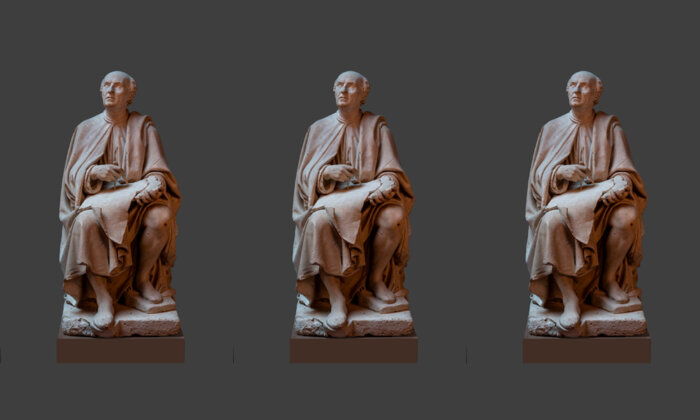
I don’t remember exactly when I first learned about Filippo Brunelleschi, but I know I wrote his name in dry-erase marker on the plastic wet wall panel that inexplicably covered the backside of my kitchen.
Brunelleschi was a true Renaissance man, remembered above all as a master architect. But it was his pig-headed, ingenious endeavor to solve one of art’s great mysteries that fascinated me. His objective was so simple that it is almost baffling no one had managed it before the 1400s: Create the illusion of three-dimensional depth on a two-dimensional page.
Maddeningly, the geometry required to crack the code of linear perspective had been understood for centuries before Brunelleschi came along. So when I learned about him hitting the streets of Florence with a mirror, a canvas with a peephole in it, and his paintbrushes, I had to know: Why was something a seven-year-old can copy the basics of so hard to get right the first time?
The answer was surprisingly simple: Until the Renaissance, artists weren’t trying to faithfully render the world exactly as we see it. Their work concerned itself with other matters like religion and monarchs, and intuitive methods of suggesting depth were usually enough. But the 1400s ushered in a new age in which rationalism was king, and with it came a desire to represent the world with a greater degree of fidelity in art. Artists (and their patrons) now wanted to depict the visible world with greater accuracy — suddenly, being able to accurately capture cityscapes, social interactions, and commercial scenes was considered important. Navigating the societal shocks of the Renaissance required a kind of agility of perspective, and the appeal of being able to create and control our representation of space, distance, and depth must have been powerful.
With hindsight, my fascination with Brunelleschi came from a place of empathy. While I can hardly compare myself to the great architect, I was also struggling with my own intellectual project: writing a book about decision-making. And even though I couldn’t quite make the link, something about the checkered journey to understanding linear perspective spoke to me.
We are, when we make decisions, like an artist desperately trying to create rational space on the canvas.
Then, late one night, I picked up the dry white marker and began sketching out a perspective study (generous!) on the wall panel. A few basic marks with the pen and the central metaphor of my book revealed itself to me: We are, when we make decisions, like an artist desperately trying to create rational space on the canvas — some things fall in the foreground, some in the background, and small errors lead to distortions. We can avoid letting those distortions spoil the whole thing by learning techniques for organizing what I termed our decisionscapes and rendering them more effectively. Just like an artist, we don’t always have to follow the rules, but knowing them helps us understand when and why deviation is serving us.
Throughout the weeks that followed, I unpacked this metaphor until I had a structure for my erstwhile chaotic manuscript. I wrote about how psychological distance creates mental diminution of decision factors. I explored how pattern recognition affects the “composition” of our decisionscapes and what that does to our perception of the world and our relationships. And I learned that “perspective” itself is ideologically charged: The Chinese didn’t adopt Brunelleschi’s system because they found it laughable that art should try and render the world as a single individual sees it. Their system — parallel projection — instead offers a supra-realistic perspective, showing far more than any one person could see.
So that is how Brunelleschi’s weird little project provided the springboard for a joyful exploration into the parallels between creating art and the psychology of decision-making. And as far as underrated social innovations go, I, for one, am persuaded that linear perspective should be at the top of the list.
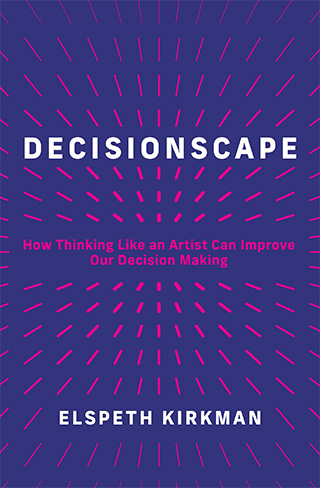
Elspeth Kirkman is Chief Programme Officer at the innovation agency Nesta and a Visiting Senior Research Fellow at King’s College London’s Policy School and Exeter University’s Business School. She is the coauthor of “Behavioral Insights” and author of “Decisionscape: How Thinking Like an Artist Can Improve Our Decision-Making.”