American Progress Was an Optical Illusion
The kaleidoscope was invented in 1816 by a Scottish scientist, Sir David Brewster. Looking through his invention, Brewster saw, at the end of the tube, shards of colored glass reflected in mirrors to create symmetrical patterns that changed as the tube was rotated, producing endless transformations. He soon realized that, viewed through the tube, anything could become kaleidoscopic: “The furniture of a room, books and papers lying on a table, pictures on the wall, a blazing fire, the moving branches and foliage of trees and shrubs, bunches of flowers, horses and cattle in a park, carriages in motion, the currents of a river, waterfalls, moving insects, the sun shining through clouds or trees.”
When Brewster’s device reached the market, the public was captivated. It seemed to magically transmute the physical world into a cascade of patterns for private viewing. But its influence eventually became figurative, too: The kaleidoscope offered a new way of seeing — one that could be extended to cultures, societies, and even nations as a whole. And by the following century, the kaleidoscopic lens had turned toward an America in great flux.
Between 1876 and 1929, Americans experienced an unprecedented increase in energy. The census found that adopting oil, gas, and electricity increased agricultural power by 800 percent and industrial power by 600 percent. The urban population mushroomed from 10 to 69 million, and factory productivity increased almost 200 percent. By 1929, every job was far different from what it had been in 1876, whether it be plowing, mining, forging steel, making cement, constructing an office building, assembling a product, or running a company. During the transition, Americans witnessed remarkable feats of engineering. There were suddenly skyscrapers, hydroelectric dams, irrigation systems, department stores, and suburbs; this was, after all, the era of the Chrysler Building, the Model T, and the Golden Gate Bridge. Meanwhile, technologies like the telephone, radio, and film accelerated mass communication.
Yet at the time, Americans did not understand that they were living through the largest energy transition in human history. Instead, they perceived a series of disconnected events. Unable to discern or conceptualize an underlying cause, they often declared the transformations around them were “kaleidoscopic.” In fact, the use of this metaphor doubled in the 1870s and quadrupled between 1900 and 1920 to describe a changing society and to celebrate a limited range of social and ethnic differences while touting technological progress and urban multiplicity.
It seemed a world of cause and effect with no losses.
As one journalist reported in Harper’s New Monthly Magazine, Pittsburgh’s mills, rivers, bridges, illuminations, and amusements were “a great kaleidoscope, showing new attractions at every turn.” Other guidebooks praised Chicago, St. Louis, Washington, D.C., and New York in similar terms, with one describing Broadway as “an ocean-tide of travel and traffic, and the eye can find food for continual interest in its changing kaleidoscope.”
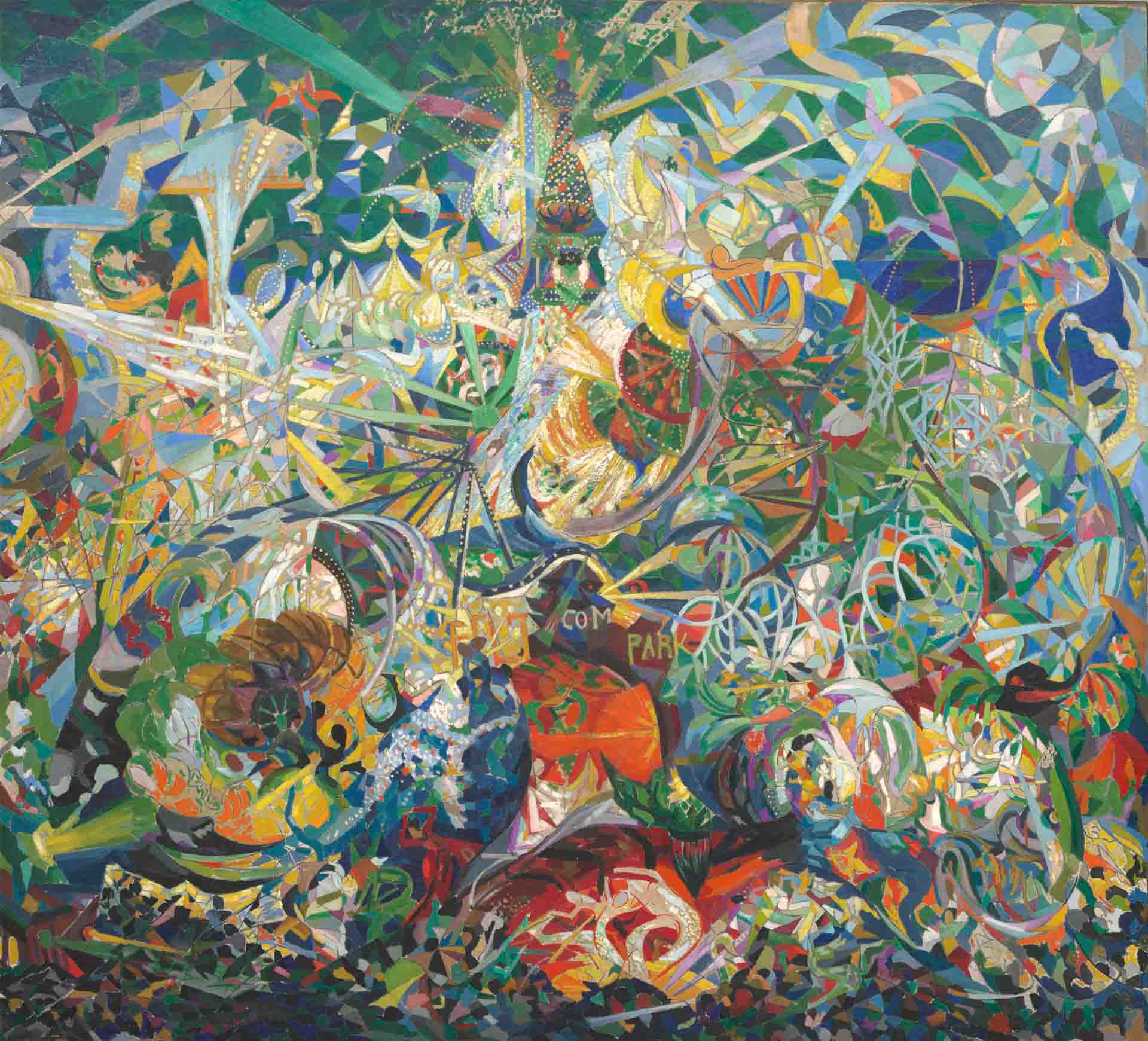
Railroads framed the passing scenery with plate glass windows. Bicycles expanded the range of daily movement. Streetcars were faster and slightly detached from the passing scene, which became an unwinding panorama. Motorists, encased in steel and partially deafened by engine noise, accepted sensory remoteness in exchange for acceleration, speed, and control. Meanwhile, for amusement, people threw themselves into the gyrations of the Charleston and other fast-paced dances, moving to 200 or even 250 beats per minute. They sought out the disorienting sensations of Ferris wheels, rollercoasters, carousels, elaborately lighted dance halls, swirling electric fountains, and spectacular fireworks. The painter Joseph Stella depicted the symphony — or cacophony — in his “Battle of Lights, Coney Island, Mardi Gras” (1913–1914), explaining like so:
“I built the most intense arabesque that I could imagine in order to convey in an [sic] hectic mood the surging crowd and the revolving machines generating for the first time not anguish and pain but violent pleasures.”
Americans saw their history as a story of unfolding progress, and the energy transition seemed not a disruption but rather an accelerated continuation. It seemed a world of cause and effect with no losses.
But losses there were. While America’s kaleidoscopic metaphor captured the beauty and propulsive force of the country’s energy revolution, it obscured its dark consequences. In the kaleidoscopic viewfinder, there was no hierarchy, no center, no dominant or subservient parts, and no explicit narrative other than the assumption of progress. Further, there seemed to be no exploitation of labor or resources, no class tensions, and no entropic losses. The disquieting instabilities of unemployment, industrial mergers, and frantic urban growth went unnoticed.
The metaphor, for example, was used to describe the new Yosemite or Yellowstone national parks in all their natural splendor. But it left little room for the destruction of the buffalo herds on the western plains, or the extinction of the passenger pigeons that once appeared by the millions, in clouds stretching from horizon to horizon.
The metaphor was used in reference to America’s industrial might. But it was not used to describe the brutal realities of the 1911 Triangle Shirtwaist Factory Fire, where 146 men, women, and children perished because the fire doors were locked, or the Avondale Fire in a Pennsylvania mine that killed over 100 workers who had no chance of escape because the blaze broke out near the only exit.
Railroads carried the same contradiction. They may have advertised the “kaleidoscopic views” along their lines, but they seldom mentioned the hollowed-out wastelands surrounding the mines that supplied iron, lead, nickel, and copper on which those lines depended. By the 1890s, the railroads served countless mining districts, where smelting operations released tons of arsenic into the atmosphere every day. In particular, they served the lead and zinc mines in Picher, Oklahoma, where dusty and poorly ventilated shafts and reduction mills created towering piles of toxic tailings. Though lead constituted less than 10 percent of the ore, the tailings contained cadmium and other chemicals that polluted the underlying aquifer. When the ore ran out, sinkholes opened, tunnels collapsed, and Picher became — and still remains — a ghost town.
Women, immigrants, sexual minorities, and the impoverished were excluded from the “kaleidoscopic” freedoms that progress was supposed to bring.
This destruction of the natural world underwrote some of the era’s most ambitious engineering and urban projects — such as the Boston Back Bay, the reversal of the Chicago River, Seattle’s Denny Regrade, New Orleans’s wetland drainage, New York City’s Jamaica Bay, and San Francisco’s Mission Bay. Growing cities seized distant rural valleys for water supplies and forced the evacuation of entire towns. Sprawling factories spread into the hinterland, polluting waterways, flattening hills, driving away or even exterminating native species, as they reshaped the land.
Even James Truslow Adams, the historian who gave the “American Dream” its name — which cast the U.S. as a land of economic and social opportunity — condemned this rampage of development. “It was not a question of preparing a continent for habitation,” he proclaimed in 1929. “It was one of money-maddened men furiously wrenching wealth from it in every way their ingenuity and greed could devise, from the land, from the forests above it, from the mines below it.”
In 1895, the Atlanta Exposition invited the African American theologian and orator John Wesley Edward Bowen Sr. to speak on “Negro Day” about his vision of rapidly changing America. His very presence was a gesture toward racial harmony, and if one reads his address as a whole, it is very much an effort to promote the abilities and the promise of Black American labor in the New South. Like many of Bowen’s white contemporaries, he drew on the kaleidoscope as a metaphor. The transformations of modern life, he said, passed before the eye “like dissolving and charming lines in the kaleidoscope,” leaving the mind overwhelmed. The “New Negro,” he argued, longed for the chance to take his place “in the ranks of one common humanity.”
But Bowen’s hopes for the future of racial harmony proved too optimistic.
While kaleidoscopic America celebrated the varieties of white, middle-class European immigrants, the same could not be said for other racial minorities. In fact, after Reconstruction, even as the metaphor became more popular, segregation increased, and in the 1890s, the Supreme Court cemented its legitimacy: All facets of African American life were circumscribed by Jim Crow laws. Denied meaningful social or economic mobility, many Black Americans were confined to the most grueling and poorly paid forms of labor — shoveling coal, washing and ironing clothes, digging ditches, and cleaning homes and streets — doing the work that kept the modern city running while being excluded from its rewards.
Meanwhile, a specter of violence, owing in part to a resurgent Ku Klux Klan, was also present. Indeed, the kaleidoscopic metaphor was ill-suited to describe the riot that burned down the Greenwood neighborhood in Tulsa in 1921, leaving thousands of Black people homeless, or to describe the 3,224 lynchings that the NAACP documented between 1889 and 1919.
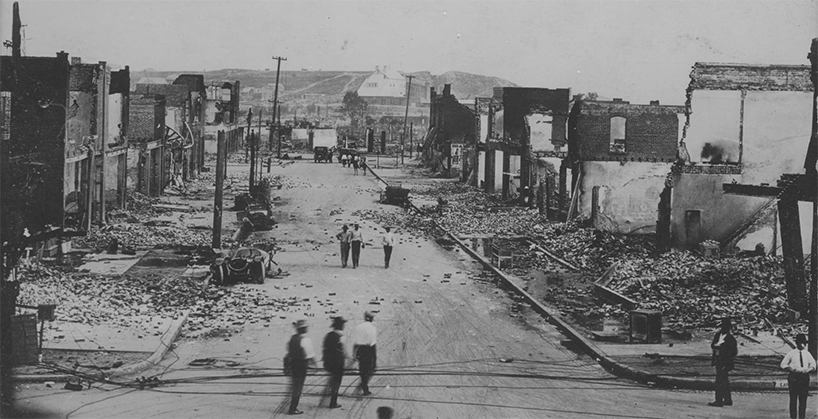
Meanwhile, women, Asian, Jewish, and Hispanic immigrants, sexual minorities, the unhoused, and impoverished sharecroppers were likewise excluded from the “kaleidoscopic” freedoms that progress was supposed to bring. In particular, Native Americans — who were expelled from their homelands to create national parks, which were later celebrated as if they had been established on vacant land — struggled to preserve their cultures against continual pressure to assimilate.
Yet, in the kaleidoscopic imaginary, all Americans were like the young white man that John Dos Passos described in the opening pages of his trilogy “U.S.A.” They had walked fast through the streets, eager to take up all the jobs and see all the sights. Their muscles stretched toward a cornucopia of jobs, laying down the new asphalt roads, fishing from trawlers on Lake Superior or off the Maine coast, riveting the steel frames of skyscrapers, driving the new interurban cars from Muncie to Indianapolis, building bungalows in the orange groves outside Los Angeles, selling electric irons and toasters to Philadelphia housewives, drilling for Texas oil, excavating the Panama Canal, making a precisionist painting, or writing a modernist novel about Chicago. It was a white man’s world of hopeful struggle.
But America was not an all-white nation, and not everyone could share equally in its promise of hope — not the women excluded from many professions, not the Black Americans living under segregation, not the Native Americans stranded on reservations. The kaleidoscopic metaphor pandered to an individualistic dream of success that even many white men would never realize: Mechanization made many redundant. More miners died of silicosis than struck it rich. Some workers suffocated in a grain silo, were electrocuted by touching a live cable, or lost a hand in a machine. Despite the prosperity, workers were restless, and in 1912, annual turnover in meat-packing plants, machine shops, textile mills, and automobile factories averaged an astonishing 115 percent.
At the end of “The Big Money,” the third volume of “U.S.A.,” Dos Passos’s young protagonist had no job, no family, and no home. While hitchhiking west, he wears a threadbare suit and broken shoes, but none of the passing cars offer him a ride. When he was young, the opportunities of America’s transition seemed limitless. But with the Great Depression, the blinders came off. Individualism was not sufficient, industrial progress was neither assured nor automatic, and the nation’s kaleidoscopic beauty was revealed as an optical (or rhetorical) illusion. The metaphor had not resolved America’s contradictions; it had only rearranged them into pleasing forms.
David E. Nye is an American historian specializing in the history of technology. His thirteen books with the MIT Press include, most recently, “The Great Energy Transition: America from 1876 to 1929.” His work has been recognized by the Leonardo da Vinci Medal in 2005 and a knighthood conferred by the Queen of Denmark in 2013.