The Cold War’s Accidental Whale Observatory
In the 1950s, after having endured relentless attacks by German U-boats during World War II, the U.S. Navy devoted considerable resources to detecting and tracking submarines at long range. Chief in this Cold War-era effort was the Office of Naval Research’s creation of the Sound Surveillance System (SOSUS), a complex array of hydrophones fixed on the ocean floor and connected by cables to secret listening stations set up along coasts all over the world.
Through SOSUS, the Navy was able to hear a lot of things: what kind of submarines were out there, how many propellers they had, whether they were conventional or nuclear, and sometimes even the exact make and model number.
But they also heard many other sounds — noises that were of less interest to them. Deep booms, grunts, howls, squeals, clicks, moans. Often, they heard monotonously repeating ultra-low-frequency tones that didn’t come from any machine they could find in their secret catalogs. What, they wondered, could be making them?
Eventually, the Navy realized the source of these mysterious calls was not any machine but whales. They kept this knowledge classified for many years. As far as the Navy was concerned, these sounds were all just “biologicals,” naturally occurring noises of no strategic import. Seamen were trained to identify them so they wouldn’t get alarmed and think that a secret enemy sound was booming across the distant seas. No one outside the Pentagon got to listen to most of these recordings until decades later, when the Soviet Union suddenly collapsed, and the Cold War ended.
Once scientists got hold of them, they were able to hear all sorts of things, which could be located with great precision. For example, geologists could suddenly locate underwater volcanoes and gain insight into how the ocean floor is constantly being created as molten lava pushes up from beneath the Earth’s crust. Biologists finally had a way to track the movements of cetaceans, such as whales, by changes in the attributes of their thousand-mile songs. Just how precisely these things can be located is one aspect of the technology that remains classified. But the system is surprisingly accurate for one that must operate in an underwater world known for its opacity.
Chris Clark is a pioneer bioacoustic scientist, now at the K. Lisa Yang Center for Conservation Bioacoustics at Cornell University. In the bowels of the beautiful Laboratory of Ornithology — a celebration of birds and all things avian — there is a pack of scientists mostly studying whales on the outskirts of Ithaca, a few hundred miles from the nearest sea. In dark rooms, they pore over piles of data, endlessly seeking similarities and differences that might bring meaning and purpose to the sounds they have collected over decades in the field.
Clark isn’t exactly sure whose idea it was to open up the SOSUS data to the cetacean research community: “I never asked for it at all. It happened in the spring of 1991, during the first Bush administration. Al Gore, Sam Nunn, and Ted Kennedy pushed through [a dual-use initiative] to take military assets for civilian science and environmental purposes. I don’t know where they got that idea.”
Out of the blue, Clark received a call from a man at the Office of Naval Research named Dennis Conlon, who asked him to come down to Norfolk and take a look at their data. He hadn’t had much experience with military culture before that. “I was amazed,” recalls Clark. “It was like Dr. Strangelove, the secret war rooms, it was real! I got a message that we would have a special meeting to discuss the Dual Uses, and I saw my name was on the agenda, and I suddenly saw I was on the program and had to give a talk about what I would do if I had access to this information. I hadn’t prepared anything, so I got up and told stories.”
And Clark knows how to tell stories. Like many scientists, he has more stories than he has ever had time to write up — stories of analysis but also speculation, ideas he has never had the chance to follow up on because he’s too busy raising money to keep his lab afloat. When Clark speaks, he reveals a side of his experience that doesn’t appear in his scientific writings. Here is a man who truly enjoys imagining what it must be like to be a whale: “From a bowhead [whale]’s point of view, migrating under the spring pack ice in the Arctic, vision is reduced down to several hundred feet, and hearing is everything.”
“It can sound like a freight train, like wolves howling, like babies crying.”
Bowheads are the only whales besides humpbacks that sing songs — a simpler song than the humpback but a song nonetheless. “It sounds as if someone is bowing a cello. Hreeaph, hmmmmr. Hreeeaph, hmmmmr. And you listen to this, and you think that maybe you’re hearing the ice grinding in the background, because they’ve incorporated these sounds of ice into their song! It’s not that surprising, because the ice has 40 different voices; it can sound like a freight train, like wolves howling, like babies crying. So, there’s this continuum of sounds from natural physical forces, such as the ice growing and stretching, all the way to the animals who are traveling through this area, this very complex underwater world beneath the ice.”
He explains his theory that the traveling whales gather together solely through listening. “Communication by sound is the means by which your comrades — excuse the term, admiral — in front of you and behind and beside you, negotiate their way through the icefield. You’ll hear hmmmm, and then 10 or 20 seconds later, mmmmmmh, and then a few minutes, then another, with space in between. We’re all connected by sound.”
Clark calls such a group of traveling whales an “acoustic herd,” a group of animals that holds itself together with sound. Their music, like work songs or spirituals, keeps the culture going: “Imagine what it must be like to be a bowhead in 24 hours of darkness, working my way through an icefield where the folklore of my culture has told me that my grandfather has been trapped and nearly died in the process. This is not like migrating across the open sea, this is frozen ocean, under the ice, by bouncing their sounds off the ice, the whales may reconstruct an image of their underwater world.”
The Navy was impressed. A couple of weeks later, Clark was called down to Washington and named chief marine mammal scientist for the dual-use initiative. “I told them, ‘Wait a minute, you guys already know all this stuff. You produced cassettes to train Navy guys who distinguish a ‘biological’ from a submarine, different guides for each ocean.’ In every training manual that I’ve found for Navy technicians, every image I’ve seen, every spectrogram, in the background, there were always whales! They had terminology for things like the ‘jezz monster,’ when all the fin whale voices come to a crescendo during the summer months, and they just tried to block that stuff out. It was a pain in the ass to them, because it made the subs harder to spot.”
On his first visit to SOSUS headquarters in 1992, Clark was ushered into a dark room the size of a gym, with row after row of dot-matrix printers spewing out scrolls covered with dashes and dots, old-fashioned representations of the sounds picked up by hydrophones stationed all over the world’s oceans. Clark peered at one printout, and he saw a familiar blip near the bottom of the scale: “Exactly the right sound frequency for a blue whale. Then, as I walked along the rows of machines, comparing the patterns from separate arrays miles apart on the ocean bottom, I noticed something else: they were detecting the same whale!”
He felt a chill on the back of his neck as he realized that the Navy’s system could be used to locate whales singing across an entire ocean: day by day, hour by hour.
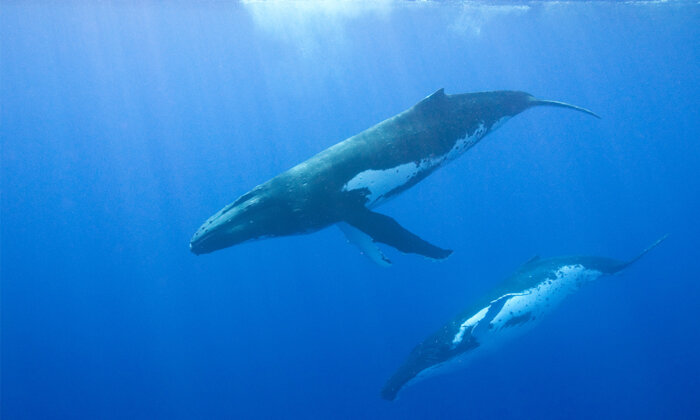
Blue whales, the largest animals that have ever lived, have 10 times as many neurons as we do devoted entirely to picking up sounds below 100 Hz — way beneath the lowest notes of the piano. We can barely hear what they are doing. A blue will make one long, dark moan lasting up to half a minute, then wait exactly 70 seconds before making the same sound again. Over and over again, in an exact but very slow rhythm, for days. In the Indian Ocean, they do it every 140 seconds.
Fin whales, the long, sleek Ferraris of the whale world, make a simpler sound: an extremely low pulse at 20 Hz repeated every 3 seconds or so, beneath the lower limit of human hearing. Because of the simple and regular nature of the fin whale’s beat, it has been easiest to use in testing the theory of the thousand-mile song.
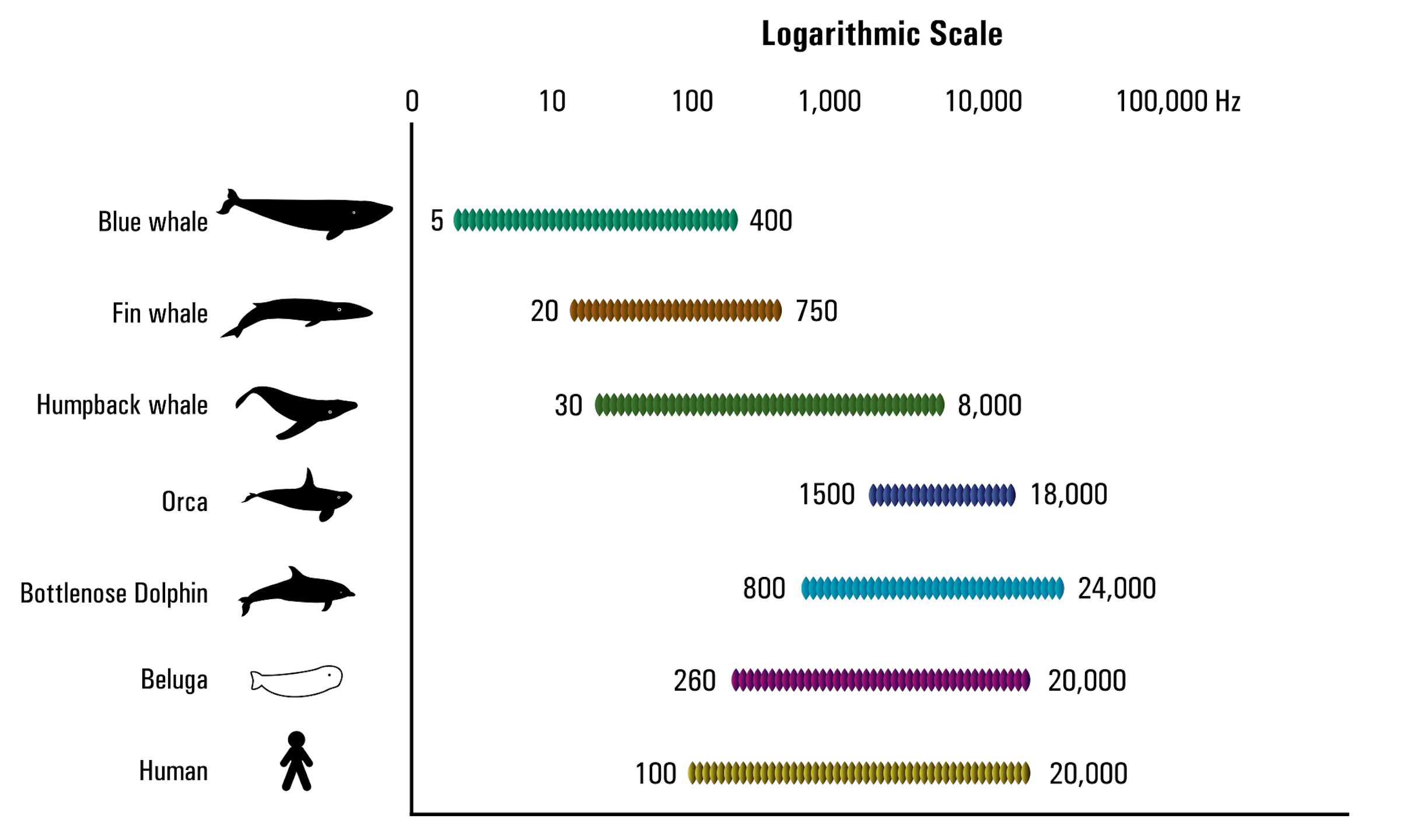
When this sound was first heard during the Cold War, some thought it was a secret frequency used by the Russians to generate standing waves in the oceans that could allow the enemy to detect the positions of our submarines. Ocean acoustics textbooks in the 1960s were still skeptical that such tones could be of animal origin. Suddenly, the Navy started paying more attention to low regular pulses. It turned out that these sounds were being made by fins. The sounds are so far apart that we can only grasp their rhythm when they are sped up 30 times.
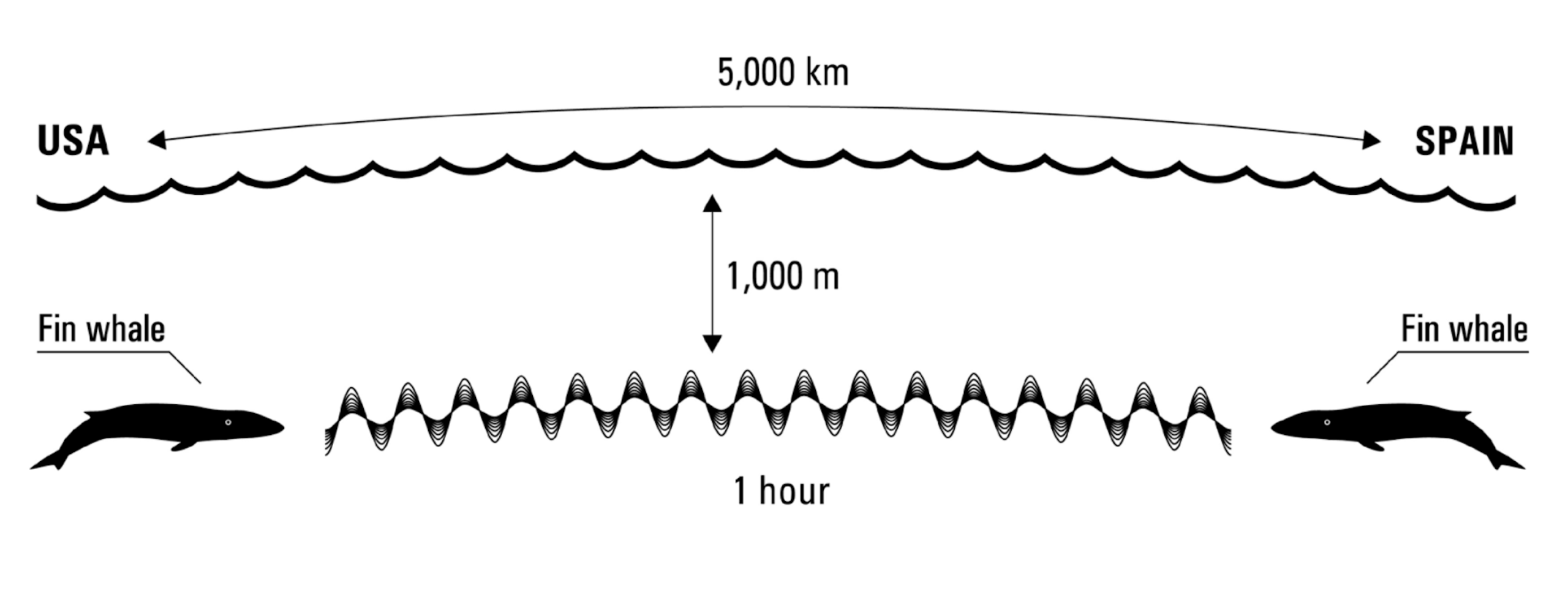
As early as the 1970s, biologist Roger Payne hypothesized that the largest whales, which make the lowest sounds, could conceivably communicate across entire oceans. Over the coming decades, it was determined that only male blues and fins were making the lowest regular sounds. Since no one had ever found breeding grounds for fin or blue whales (whalers had sought such a gold mine for centuries), scientists began to suppose that such a place was not needed. Perhaps, as male whales called out for mates across thousands of miles, the females who heard would then head toward the source of the sound.
But again, this is all just speculation. The question still stands: Do whales themselves actually listen to songs from thousands of miles away?
Serge Masse, a Montreal-based developer of cetacean research software (his latest creation is DC Dolphin Communicator, an Android app designed for two-way dolphin/human communication), remembers a Navy sonar man he knew who tracked fin whale booms in the 1970s. Loud ones were detected right near his submarine, off Stellwagen Bank near Cape Cod, but there were very faint echoes that couldn’t be placed. On the phone with colleagues near Spain, he got confirmation that whales off the European coast were making similar subsonic booms just an hour before. Why wasn’t this published?
“The information remained classified for decades,” Masse smiles. “But now it can be told.”
Scientists, though, have certainly heard baleen whale sounds from great distances away. With access to the Navy’s super-accurate equipment, Chris Clark was able to track a blue whale for 43 days from a thousand miles away. This giant blue whale sang day and night continuously. He began 500 miles northeast of Bermuda, swimming on a steady south-southwest course for three days. He passed just south of an undersea mountain and then turned toward the west and swam until he was 200 miles northeast of Cuba. Then he turned right and ended up about a hundred miles from where he began. There, he fell silent. Altogether, this whale traveled 2,200 miles over the course of a month and 13 days.
Clark believes the whale may have echolocated off the seamount and then off Bermuda for navigation. Even such deep sounds could be used for echolocation, especially if they are sung with such rhythmic precision, by an animal hip to long, drawn-out scales of time. Blue whale sounds at their source are 180 dB, as loud in water as a jet engine is in the air. You wouldn’t want to be listening too closely to one. We would likely feel a huge rumble throughout our bodies if we swam nearby.
No human musician could stay in time counting as slowly as these whales do.
What is this long, simple song then? A mating ritual, or a form of slow-motion sonar? Clark has shown that the mathematics for deep booming sonar could work, but there is no data to support that this is what is actually going on.
Yet the thousand-mile song takes hold of our imagination right away: “I could show you the evidence today. I can listen in Puerto Rico to a whale way up on the Grand Banks. Can the whales do that? You might well ask, ‘What would they have to say?’ Then you’re suddenly putting on this silly human restriction. A whale might turn around and say to me, ‘What would you possibly have to say to one another sitting just two meters apart?’”
Like so many great scientists, Clark is not afraid to be a bit of a dreamer. More than once, he has sought out the advice of musicologists: “Marty Hatch, a specialist in Indonesian gamelan here at Cornell, had this to say to me, ‘You know Chris, you look at all this singing as data, but I think of it as a musical, emotional experience.’ Musicians hear song, and this is where I sometimes lean away from the scientific and tend to agree with them. Why can’t we just appreciate it as a phenomenon that is phenomenal?”
No human musician could stay in time counting as slowly as these whales do. These incredibly low thumps and moans are rhythms at such a lax pace that they are barely perceptible to human beings. Speed a blue whale song up 10 times, and 30 minutes becomes three. Move the pitch up to the realm of a cello, bowhead song, or a human moan, and exactly every three seconds comes the same soft moan. Only when we slow down time do we hear the thousand-mile song, a great sigh in the deep sound channel, echoing from one end of an ocean to another.
David Rothenberg, a musician and philosopher, is Distinguished Professor at the New Jersey Institute of Technology. He is the author of “Why Birds Sing” (Hachette), “Bug Music” (Macmillan), “Survival of the Beautiful” (Bloomsbury), and “Whale Music” (Terra Nova), from which this article is adapted.