The 1960s Art School Experiment That Redefined Creativity
This article is part of our Footnotes series, in which authors reflect on a person, study, or curiosity — whether obscure, well-known, recent, or historical — that sparked or challenged their thinking, or never quite made it into their work.
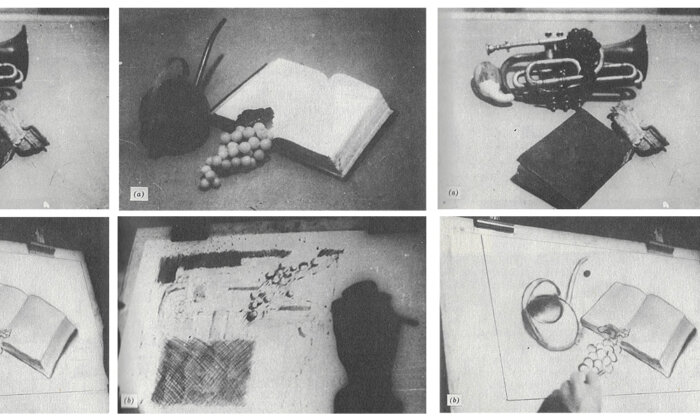
The year is 1964. An art school student is in a studio, sketching a still life. But it’s no ordinary studio. A researcher in the corner is watching closely and taking notes. The student has been given only one hour to complete the sketch. His still life must be composed from a set of 27 carefully chosen objects, including a bunch of grapes, a steel gearshift, an antique book, and a glass prism. He is instructed to select any number of them, move them to an empty table, arrange them, and start drawing.
One by one, 31 art students visit this experimental studio, and each makes a sketch in one hour, choosing from the same 27 objects, using the same easel, pencils, and charcoal.
The scene was part of a study conducted by the legendary psychologist (and my doctoral advisor) Mihaly Csikszentmihalyi and his colleague Jacob Getzels, who were interested in how artists approach the creative process. What they found was striking. About half the students moved quickly to choose their objects, arrange them, and draw a rough outline of their sketch. It seemed that they knew what they were going to draw before they even started. They spent the rest of the hour developing their original idea into a final work. The other half spent far longer exploring: picking objects up, turning them over, changing arrangements, switching materials, erasing, and starting again. Some of these artists experimented for as long as 50 minutes and had to rush to finish something by the deadline.
The first group of artists treated the task as a problem to solve. The second group spent much of their time finding and formulating a visual problem.

The discovery of this “problem-finding” creative process was a seminal moment in creativity research. In the decades since, countless researchers have shown that many of the most meaningful forms of real-world creativity and invention depend less on solving well-defined problems than on figuring out what the problem is in the first place. That’s especially true of today’s so-called “wicked problems”: complex, ill-defined problems with no obvious correct solution.
Problem-finding creativity was first described in a 1976 book called “The Creative Vision,” the second book by Csikszentmihalyi. Long out of print, it remains one of the most important books about creativity in the 20th century, and a lodestar for me. It not only defined and theorized problem-finding but also provided empirical evidence that a problem-finding approach led to greater creativity and success in creative careers.
The artist study offered that evidence early. Csikszentmihalyi and Getzels would, with the help of a board of art critics, go on to find that the problem-finding artists produced the more original and aesthetically compelling work. What’s more, the pattern held over time. Five years after graduation, the researchers tracked down 27 of the students and interviewed them to see whether they were still painting and how successful they had been. Did their creative style in art school have any impact on their career success? The researchers developed a series of quantitative measures. Did they have gallery shows and dealer representation? Had they sold any paintings? Was their work in any museums? Were they art teachers, or curators, or some other art-adjacent career? Had they stopped painting altogether and moved on to a different profession? Their findings were decisive: The artists who used a problem-finding style while in school were far more successful five years after graduation. Of the 11 students who were the least problem-finding in approach, eight had dropped out of art altogether.
My own research career has been deeply influenced by “The Creative Vision.” In my book “Learning to See,” I followed Csikszentmihalyi’s lead, studying how artists and designers actually work and how the best art teachers teach. What emerged was a consistent pattern: The best professors are teaching students how to create in this problem-finding style and carve out a path of their own. Perhaps it’s no coincidence that I did several of my interviews at the very same institution featured in the original study: The School of the Art Institute of Chicago.
Csikszentmihalyi understood that creativity does not begin with a solution, or even with a clearly defined problem. It begins earlier, in a more uncertain and searching state of mind. As he wrote in “The Creative Vision”: “This ability to formulate problems seems to be a faculty of a different order. It entails a process far more in touch with the deeper layers of being than reason alone usually is; it is far more holistic in that it encompasses the person’s total experiential state. Problem finding may well be at the origin of the creative process.”
Keith Sawyer is one of the world’s leading researchers on creativity. He has published 20 books, including “Group Genius,” “Zig Zag,” and, most recently, “Learning to See.” Sawyer is the Morgan Distinguished Professor in Educational Innovations at the University of North Carolina at Chapel Hill. He’s the host of the podcast “The Science of Creativity.” You can also follow his writing on Substack.