Paying My Respects to a Linguistic Virtuoso
This article is part of our Footnotes series, in which authors reflect on a person, study, or curiosity — whether obscure, well-known, recent, or historical — that sparked or challenged their thinking, or never quite made it into their work.
On a flight from Myanmar in 2010, I struck up a conversation with a fellow passenger. Leo was born in the United States, had gone to Williams College, cycled across the United States three times, and in his junior year, went to Hong Kong, where he married and has lived for the last 60-plus years. When I asked him what kept him in this part of the world, he said that, aside from his wife Elaine, it was the Far East. He’d been to Nepal, Bhutan, India, Laos, Cambodia, Vietnam, Mongolia, and, of course, Myanmar. He had trekked the high country of Nepal, India, and Bhutan on nearly 40 occasions.
The conversation then turned to me. When he learned I was a linguist at MIT, his attention was piqued. He described an obituary he’d read 10 years earlier that had stayed with him. It was about a linguist who spoke 50 languages. He couldn’t remember his name.
“Ken Hale,” I said.
Leo was astonished. “You knew him?”
“I wrote a book with him.”
His mouth dropped open. I savored that moment. I could hear him retelling the story over and over again just the way I am now.
“What can you tell me about him?” Leo asked.
“Well, to start, there were parts of him that were like you. He also lived outside the box. He grew up on a ranch in Arizona. He rode horseback to a one-room schoolhouse near Canelo, Arizona, when he was a boy. He had a gift for languages the way Mozart had a gift for music. He went to the Verde Valley School near Sedona. There he roomed with a Jemez speaker and a Hopi speaker. He quickly became fluent in both their languages. He learned Spanish on his own. He learned Navajo from a college roommate. His high school language teacher wanted him to stop learning so many languages. Ken said he didn’t understand that learning more than one at a time was a help, not a hindrance.”

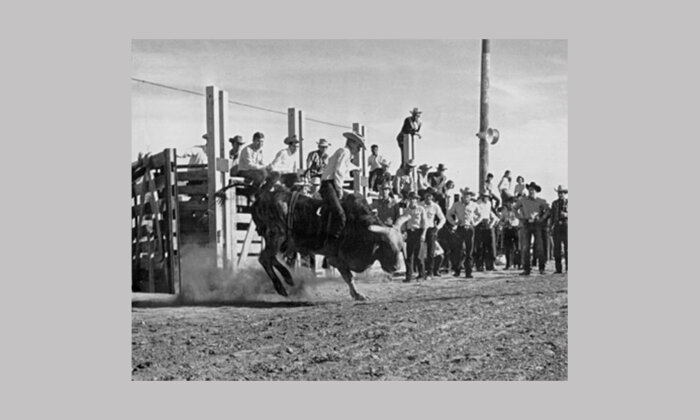
“When Ken was 20, he was the Brahma bull riding champion of Tucson, Arizona. He won a belt buckle and wore it every day to work at MIT. He once told me that if he hadn’t gone into linguistics, he would’ve been a gunsmith.”
“I remember once accompanying him to the Irish Consulate in New York City. He needed a visa. He began by speaking Gaelic to the woman behind the counter. After a few minutes, she asked him if he spoke English. She said her Gaelic wasn’t as good as his. But he was more than just a polyglot, someone who knows a lot of languages. He was one of the best theoretical linguists of the 20th century.”
In grammar school, we learned that sentences were made up of subjects and predicates, the predicate being the verb phrase “ate the apples” in a sentence like “The horses ate the apples.” Most languages in the world have verb phrases. Ken pioneered the study of languages that didn’t, like Warlpiri and Mohawk. Called non-configurational languages, this work opened another door to understanding what it means for a human being to speak a language.
His work on the syntax of lexical items, so-called argument structure, explained how verbs can determine the clausal structure of sentences in which they occur. For example, we can say The baby cried, but not John cried the baby, while we can say both The ice melted and John melted the ice. The explanation he and I developed together is now standard in the field.
Ken’s bibliographical memoir, written for the National Academy of Science by Morris Halle and Norvin Richard, ends this way:
Hale worked on historical reconstruction of the Australian language families, on intonation in Tohono O’odham, on stress in Hoca‘k, on agreement in Irish and K’ichee,’ on the phonology and semantics of a sacred initiation language of the Lardil called Damin, and on countless syntactic issues in languages from Warlpiri to Dagur to Navajo. He produced dictionaries of Lardil and of Ulwa, and contributed extensively to a dictionary of Warlpiri, and to educational materials in countless other endangered languages. He was the first, and in many cases, the only researcher to document the vocabulary and structure of dozens of aboriginal languages of Australia.
That flight was 16 years ago. Leo and I still exchange emails, most often him sending me photographs of his latest trek. We have become friends, introduced to one another by a man who died 10 years earlier.
I think that is one measure of greatness.
Samuel Jay Keyser is a theoretical linguist. He is Peter de Florez Emeritus Professor of the Linguistics and Philosophy faculty, and former Associate Provost at MIT. He has authored numerous books, including “The Mental Life of Modernism” and “Play It Again, Sam,” and is Editor-in-Chief of the journal Linguistic Inquiry.