The Radical Tub
When I get out of the bath, I want to feel transformed, to emerge renewed like the goddess Hera at her annual bath in the spring of Kanathos, or Aphrodite in the sea — or as close to this as possible. I want to be reborn in some sense. This takes time. The better I feel afterward, the better the bath.
I wonder if I have enjoyed every bath I have taken as poet Sylvia Plath does in her 1971 novel “The Bell Jar”:
There must be quite a few things a hot bath won’t cure, but I don’t know many of them. Whenever I’m sad I’m going to die, or so nervous I can’t sleep, or in love with somebody I won’t be seeing for a week, I slump down just so far and then I say: “I’ll go take a hot bath.” I meditate in the bath. The water needs to be very hot, so hot you can barely stand putting your foot in it. Then you lower yourself, inch by inch, till the water’s up to your neck. I remember the ceiling over every bathtub I’ve stretched out in. I remember the texture of the ceilings and the cracks and the colors and the damp spots and the light fixtures. I remember the tubs, too: the antique griffin-legged tubs, and the modern coffin-shaped tubs, and the fancy pink marble tubs overlooking indoor lily ponds, and I remember the shapes and sizes of the water taps and the different sorts of soap holders. … I never feel so much myself as when I’m in a hot bath. I lay in that tub on the seventeenth floor of this hotel for-women-only, high up over the jazz and push of New York, for near onto an hour, and I felt myself growing pure again. I don’t believe in baptism or the waters of Jordan or anything like that, but I guess I feel about a hot bath the way those religious people feel about holy water.
While this is not a text in praise of domesticity, each of these singular containers is presented to her memory fondly, held like a dish, a bowl, or maybe a cup. The bathtub likes to sit in isolation, and usually tries to be an object, visible from as many sides as possible. We think that it is for one, but we know that, really, two could fit in without much trouble. If we can fit more than two people in a tub, it will change name, perhaps becoming a hot tub.
There is a problem that bathtubs pose to the designer, and ergonomics is one way in which designers have tried to address it. What constitutes the optimum bodily position in the bath? It seems that anthropologist Marcel Mauss might have been grappling with a related question in his 1934 essay “Techniques of the Body,” which envisioned a future, global “socio-psycho-biological study” of what might be called habits, gestures, and practices of the body. Sitting, standing, dancing, bathing, drinking — these habits enfold physiological, psychological, social, and sexual dimensions, at once natural and cultural, specific and vast. Read this way, Mauss anticipates a kind of social ergonomics, one that asks not only how bodies fit objects, but what bodies are doing and what kinds of social space they create.
In Turkey, you lie prone on a heated platform, then sit on a bench in a personalized niche with a basin collecting water, which you then throw over yourself. You are with children and friends.
In Japan, you squat to collect the water, dowse and scrub yourself, then enter a deep tub to soak, sitting with knees bent up. At home or at the sentō, you are usually with family members.
In Finland, you sit on tiered benches to sweat, then jump into the lake to rinse and cool off. You are with your family and friends.
In India, you walk into the river, submerge yourself three times, then walk back out. You are surrounded by neighbors doing the same thing before they go about their daily lives.
In ancient Rome, you rubbed your skin with oil, then sweated, then scraped yourself with a strigil. This curved metal tool for exfoliation scraped off the dirty oil and dead skin, leaving pores open and clear. You were surrounded by the free people of your town; you had finished your work for the day, and this was time for networking with business associates, catching up on political and social gossip, and sexual and dining invitations.
In Jordan, you float effortlessly on a salty sea, looking at the sky. You are with other pilgrims from around the world who have come to pay homage to an ancestral land.
In North America, you stand up with water pouring down on you from above when you wake up, or lie horizontally in a coffin-shaped tub to help you drift toward sleep. You are alone with the door closed, hoping not to be disturbed.
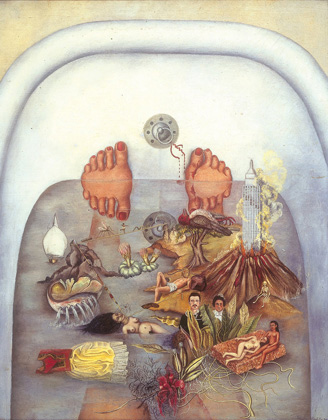
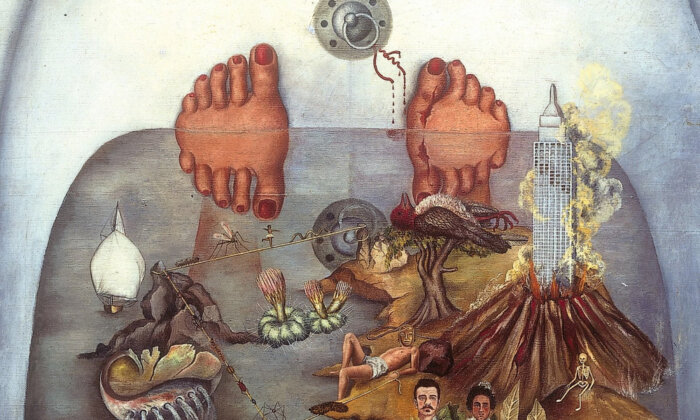
Frida Kahlo’s painting “What the Water Gave Me” (1938) is taken from the vantage point of the artist in her bath. Floating in the water are scenes, people, body organs, landscapes, that seem to be taken from different moments of her life. Here we have a dissolution of time and space as Kahlo swims in a reverie of her entire life, coupled with the security of being held by the tub. The function of seeing is directed toward the inner eye of the artist as she moves both inward toward emotions and memories, and outward toward a whole life’s journey.
There is a kind of autoeroticism in self-absorption that has a particular cosmic relation or aggrandizement, suggesting another meaning to the bath’s experiential immersive reverie. Bathing’s autoeroticism can manifest in both the solo and the collective bath space, and the self-absorption of the bather in a group can be a powerful statement to others. Bathing architectures engage with these erotic dynamics in a variety of ways. Looking at the scarring on her foot and leg, we are reminded of Kahlo’s physical disability dating from childhood polio and a bus accident in 1925; the private bath is a space of respite and rest for her body. We can imagine the difficulty of Kahlo’s entering and exiting her tub. Lifelong self-sufficiency and able-bodiedness is an illusion that continues to be exploited and perpetuated for the economic gain of a few and the suffering of many. If we reimagined baths as shared spaces, they would offer us more flexibility and generosity, and recognize our need for others at so many stages of our lives.
Some relief from gravity is felt in water, and we sense the difficulty of the artist’s thoughts mingled with gratitude for finding a place of comfort. In the bathtub we would like to float if we could, effortlessly as if in the Dead Sea, where salt comprises 33.7 percent of the water. Pure and effortless horizontality is a unique ontological proposition. Though it is longer in duration, sleeping falls short in comparison, with our morning aches and constant movement through the night.
This effortlessness is possible in a large enough tub, the floatation tank. The origins of the float or isolation tank lie in the sensory deprivation experiments of the radical neuro-psychiatrist John C. Lilly in the 1950s. His interest in exploring the nature of the mind and psychedelics resulted in the creation of a sensory deprivation suit resembling an astronaut’s. As experiments evolved toward a dark and silent salty sea, Lilly’s subjects started to enjoy the experience more and emerged from the experiments feeling relaxed and rejuvenated. The lightless, soundproof tank contained highly salinated water, saturated with magnesium sulfate (Epsom salts) to a density of 25 percent and maintained at 34°C, matching skin temperature and eliminating thermal sensation. The magnesium is absorbed through the skin as needed, making the body effortlessly buoyant. Lilly invited notable psychedelic intellectuals to try out his tanks in the 1950s and 1960s; visitors included Timothy Leary, Carl Sagan, Allen Ginsberg, and physicist Richard Feynman, who describes his many experiences at Lilly’s tank in his autobiography.
A sense-deprivation tank is like a big bathtub, but with a cover that comes down. It’s completely dark inside, and because the cover is thick, there’s no sound. There’s a little pump that pumps air in, but it turns out you don’t need to worry about air because the volume of air is rather large, and you’re only in there for two or three hours, and you don’t really consume a lot of air when you breathe normally. Mr. Lilly said that the pumps were there to put people at ease, so I figured it’s just psychological, and asked him to turn the pump off, because it made a little bit of noise. The water in the tank has Epsom salts in it to make it denser than normal water, so you float in it rather easily. The temperature is kept at body temperature, or 94, or something — he had it all figured out. There wasn’t supposed to be any light, any sound, any temperature sensation, no nothing!
Feynman’s description proceeds to his experiences of hallucinations in the floatation tank, in combination with different mind-altering substances ranging from marijuana to LSD, as inquiries into the nature of memory, the difference between wakefulness and dreams, and proprioception, the sensation of body position and movement. At a certain point, he became convinced he could replicate any of the experiences he had in the tank just by sitting in his living room, so he stopped the practice. At the end of the passage, however, he says he never managed to succeed.
Architects of bathing would benefit from a greater understanding of the interfaces between neurology, biology, psychology, and physiology.
Lilly’s work on sensory deprivation explored the subtle interrelationships between body, mind, and consciousness. In “The Deep Self” (1977), he examined how the floatation tank could be used as an aid for understanding one’s state of being, a practice that extends beyond the tank itself into everyday life. Architects of bathing would benefit from a greater understanding of the interfaces between neurology, biology, psychology, and physiology.
Floatation tanks grew in popularity. Inspired by a workshop Lilly gave in 1972, Glenn Perry designed the first commercial isolation tank made to Lilly’s specifications. He investigated the properties of anechoic chambers and a multitude of materials from plywood and fiberglass to cardboard and vinyl, settling on rigid plastic. Perry opened the first floatation tank establishment in Beverly Hills in 1979. Today, commercial floatation tank establishments can be found in most cities, advertising relaxation, relief from anxiety and high blood pressure, in organically shaped fiberglass pods.
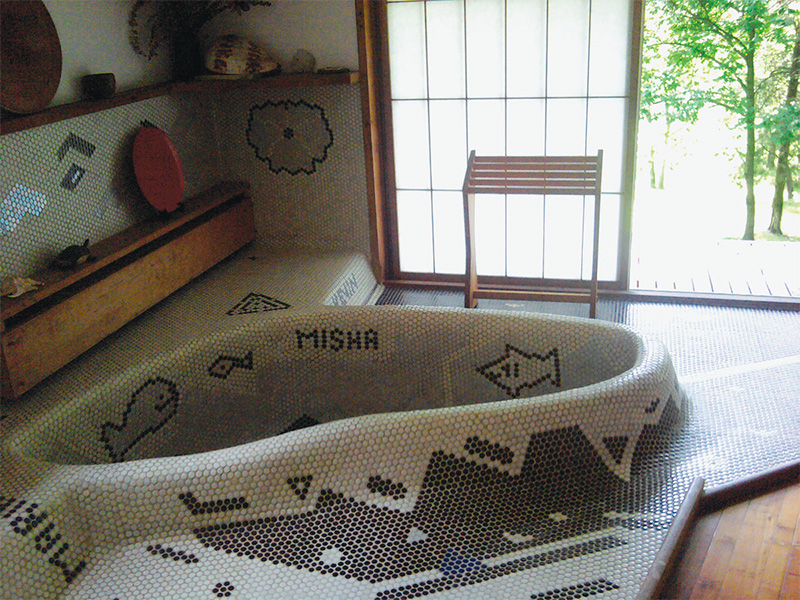
Japanese-American designer George Nakashima designed and built a bathtub that contested industrial prefabrication and exemplifies the movement to reimagine the tub, and architecture, in the 20th century. Throughout the 1960s, as he developed his living and working compound in New Hope, Pennsylvania, filled with experimental structures built with minimal means, he incorporated elements of the Japanese family tub into an American home to create a unique and beautiful social space. The floor slides up and over into the tub as a continuous surface, like an extension of the landscape we see beyond. Sliding doors combine the inside and outside, and no walls separate this tub from the living space. The tile patterns include playful fish mosaics and the names of his kids, and we can only imagine the delight of the Nakashima children soaking and splashing here together at the end of the day, with the breezes blowing in across the water. Where Nakashima reimagined the bath through craft and lived experience, others approached it analytically.
Architecture professor Alexander Kira’s 1976 book “The Bathroom” offered a critique of the bourgeois American bathroom based on a rational analysis of the failings of mass production, not to overthrow it but to better it. He brings a pragmatic, materialist, almost fearlessly Reichian lens to a set of forms that he sees as mutable and unsatisfactory.
Compared with kitchen design, he thinks that innovation in bath design lags far behind for most people due to prudishness. Kira claims that the Western distaste for even discussing basic bodily functions such as washing, pissing, shitting, and shaving has led us to neglect the design of an important room we use multiple times a day. Combined with a puritanical repression of the body and bodily pleasure, this has produced the modern bathroom: a sterile, barely even utilitarian space, a collection of fixtures lacking intelligent responses to basic needs. Taking a careful look at the bodily movements of people of different ages, shapes, and abilities, he offers to rectify this through ergonomics: The home bathroom could be better designed using analytical tools.
Kira claims that the Western distaste for even discussing basic bodily functions such as washing, pissing, shitting, and shaving has led us to neglect the design of an important room we use multiple times a day.
The majority of ergonomic studies and architectural graphic standards suggest isolation in their descriptions of space needs for single bodies, not multiple, interactive ones. The continual struggle for a parent to bathe a small child, or a child to bathe their ailing parent, in a typical contemporary bathroom underscores the basic problem. Every aging person is expected to need a total renovation of their home bathroom at some point in this design. Why are these simple concerns for age difference, let alone cultural or sexual differences, not met at the outset? Kira’s publication was ahead of its time; today, the average person expects their house to offer roughly the same fixtures in the same locations as a tenement dweller of 1920. While Kira’s study is pragmatically focused on the base unit of the private domestic bathroom, the public bath haunts it as a distant ideal practiced elsewhere: “In many parts of the world bathing is viewed and practiced as a shared, pleasurable activity,” he writes — “a scarcely possible feat in the average American five-by-seven-foot bathroom, even if this desire were present.”
The battle between shower and bath as the standard means of cleaning oneself has produced a compromise in the industrialized bath of a combined space, which is perfectly suited to neither: a flat-bottomed shallow tub that you cannot lie comfortably in, and a slippery concave surface to stand on while showering upright. Kira’s concerns are addressed again in the work of architecture professor Galen Cranz. After studying at UC Berkeley in the 1970s, Cranz combined her training in design and Alexander technique to revisit design from the viewpoint of the body. Her interpretation of body-conscious design comes together in her 1998 book “The Chair,” a deepening of ergonomics that developed from the inside out. Here she applies her method to the neck-ache-inducing American tub:
Lying down should be easy in the privacy of your own bath. Why are American bathtubs usually designed so that lying down is impossible? Their size and shape forces one to stoop while bathing — no wonder so many people, especially tall ones, prefer to shower. If one tries to recline, the head and neck hit an awkward edge. Why not lie flat, fully extending the spine to float on the water? Even elaborate and expensive whirlpool tubs have not solved this problem. Little inflatable plastic pillows are as close as anyone has come to body consciousness in bathing. The institution of bathing could easily be revolutionized in the United States.
The same year that “The Bathroom” was published, another publication on bathing with a decidedly different approach was launched in San Francisco. Architecture school graduate Leonard Koren ran Wet: The Magazine of Gourmet Bathing until 1981. That this apotheosis of West Coast cool took bathing as a touchstone to discuss fashion, music, art, food, and everyday life reminds us of the importance of bathing and the body in Californian culture generally, and in the 1970s particularly. The magazine’s humor and irreverence connected it to punk and new wave cultures, as well as the famous bathing-based parties that Koren would throw in old urban bathhouses, backyard pools, and clubs. Koren’s writing in Wet is full of funny, subtly poetic insights weaving between sensuality, spirituality, the life of the mind, and social relations.

There was an urgency to the critique of the bathroom in the 1970s in parallel with a revolt against modernism and the industrialized world, and the decade produced many stimulating designs and texts for the architecture of bathing. If the division of labor under capitalist production fragmented the body and its gestures into a collection of utilitarian machine parts that the tub represents, philosopher Félix Guattari envisioned in his 1975 essay “To Have Done with the Massacre of the Body” a revolution that would reground us in the body:
We have begun with the body, the revolutionary body, as a place where “subversive” energies are produced — and a place where in truth all kinds of cruelties and oppressions have been perpetuated. By connecting “political” practice to the reality of this body and its functioning, by working collectively to find means to liberate this body, we have already begun to create a new social reality in which the maximum of ecstasy is combined with the maximum of consciousness.
In 1978, the standard manual for back-to-the-land bathing came from California: “Sweat.” Mikkel Aaland’s countercultural bathing classic brought together scholarly research, a healthy irreverence for authority, and the wisdom of everyman the bather, with Rabelaisian humor. Aaland’s chapters on sweat traditions include the Americas and Japan, and stories of his experiences as he travels the world in search of a good sweat. The final section gives instructions for making a variety of simple sweat baths yourself. “Sweat” embraces in its very title an unapologetic corporeality that can hold the blood, sweat, and tears of real life. “Sweat” was typical of countercultural American bathing thought during the 1960s and 1970s: Whole Earth style, critical of modernity and seeking a deeper connection to the sensual and the environment.
In 1996, Koren assembled his thoughts in a form aimed at design students in the provocative “Undesigning the Bath.” The thesis of this text is that the very act of designing, as it is commonly taught and practiced, is inimical to the creation of a great bath. Greatness here being contextualized by an anti-modern, anti-utopian treatise. Basing his book on a lifetime of world bathing, Koren uses minimal text and maximal gritty images to offer advice to those pursuing an architecture of bathing.
The argument of “Undesigning the Bath” is polemical, and he identifies qualities of a great bath experience (including pleasure, timelessness, and thermal stimulation); the obstacles to making such a place (including egoism, industrialized approach, veiled misanthropy); and techniques for undoing your design education (cultivating discovery, poetry, and a relationship to nature). It contains a dig at Kira and the ergonomic approach for missing a major point.
The look of a bathhouse may be important in signaling its function and ambition, and for publication, we rely on the image to communicate. But for the repeat bather, the image is at best irrelevant, at worst misleading. What counts is how the bath feels, the atmosphere, where embodied perception and social interaction are viscerally and unforgettably experienced. No amount of measuring can get us there.
Christie Pearson is an award-winning architect, writer, and urban interventionist. An Adjunct Professor at the University of Waterloo School of Architecture, she is coeditor of the architectural journal Scapegoat and the author of “The Architecture of Bathing,” from which this article is adapted.