The Grand Old Illusion of ‘Ethical’ Capitalism
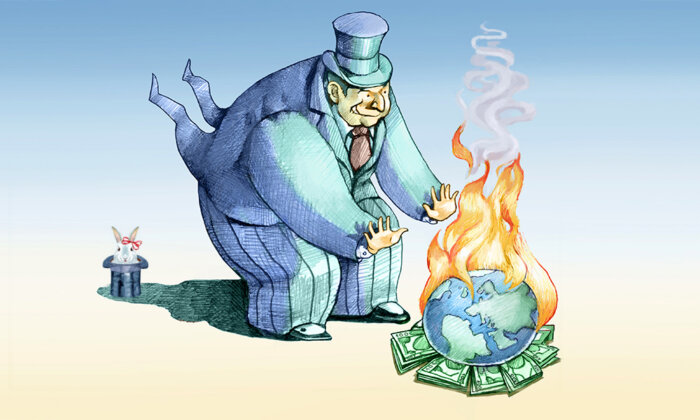
Donald Trump has long called global warming a hoax, but his sweeping anti-climate agenda has stunned even many of his supporters. Since returning to the White House, he’s withdrawn the U.S. from the Paris Treaty, rolled back critical greenhouse gas regulations, and opened up millions of acres of previously protected public land for oil and gas drilling.
In response, big oil and gas companies have abandoned, without the slightest resistance, the showy public commitments they had previously made to climate transition. For example, BP has slashed green energy expenditures by 70 percent, Equinor has cut back its renewable capacity targets by almost 40 percent, and Chevron has reduced its carbon-reduction capital expenditures to about 5 percent of its total capital expenditures. None of the world’s 12 largest oil and gas companies plan to decrease fossil fuel production, and all of them project that fossil fuels will continue to overwhelm other sources of energy for the foreseeable future, according to a recent evaluation.
Far from a change of heart, this is simply Big Oil returning to form. The petroleum industry has never been serious about curbing emissions, 90 percent of which globally come from fossil fuels. Indeed, after decades of investment, renewables still account for a minuscule amount — about 0.13 percent — of total energy produced by the world’s largest 250 oil and gas companies, according to a recent research paper. “I think the article resolves the debate on whether the fossil fuel industry is honestly engaging with the climate crisis or not,” said the paper’s lead researcher. “Their interest ends with their profits.”
Some oil companies, such as ExxonMobil, continue to promise to reduce emissions to net zero by 2050. This appears to align them with the consensus of climate science that this is necessary globally to limit warming to 1.5° C (2.7° F) above pre-industrial levels. However, Exxon is typical in designating a narrow target of greenhouse gases to eliminate: only those from its own operations, mainly pumping and refining oil and gas, and from buying electricity generated by fossil fuels. This conveniently ignores greenhouse gases from the consumption of its gasoline and other petroleum products, as well as those of its suppliers — which exceed by four times the total covered by Exxon’s commitment.
Exxon wants us to believe that running its pump jacks and refineries on solar and wind power puts it on the side of the climate transition. It’s cynical buffoonery. But it’s also a sign that America’s leaders and electorate have been willfully blind. We should have realized that companies, like Exxon, that knowingly act in pursuit of catastrophe cannot be trusted to stop of their own accord. As Shakespeare might have said, “The fault, dear Brutus, is not in Big Oil but in ourselves.”
The past is prologue. Ever since the advent of industrial capitalism in America in the early 1800s, corporations have consistently served one master, shareholders, delivering them profits by open competition in free markets. From the start, elites have insisted that corporations must regard financial and social objectives as mutually exclusive, even as a single-minded quest for profitability has pushed the system to its breaking point.
We saw the injustice of this belief in the late 19th century, when “robber barons” — who had clawed their way to the top of an unregulated, chaotic economy — justified poverty wages and harsh working conditions by co-opting Charles Darwin’s new theory of evolution, popularized as “survival of the fittest.” Railroad magnate Charles Elliott Perkins — who embodied Social Darwinism by rising from office boy to president of one of the nation’s largest railroads — declared his creed: “That a man is entitled to a living wage is absurd….[If] you take from the strong to give to the weak, you encourage weakness; therefore, let men reap what they and their progenitors sow.”
Early capitalism was marred by periodic, destructive economic downturns. But over time, government acquired fiscal and monetary tools to smooth the boom-and-bust cycles and soften the hard edges of fierce profit-seeking through welfare programs, especially during the Progressive Era (1890s–1920) and the New Deal (1933–1938).
America’s leaders and electorate have been willfully blind.
However, the bedrock of the corporate mission stayed solid even as the government built new structures on top of it. During the New Deal, for example, leading industrialists joined the American Liberty League to oppose innovations like Social Security. A League leader, echoing his counterpart six decades earlier, proclaimed, “You can’t recover prosperity by seizing the accumulation of the thrifty and distributing it to the thriftless and unlucky.”
The permanent establishment of a taxpayer-funded social safety net in the postwar period only reaffirmed corporations’ unwavering fealty to shareholder value. The president of the mighty Dow Chemical Company, Leland Doan, wrote in 1957, “Any activity labeled ‘social responsibility’ must be judged in terms of whether it is somehow beneficial to the immediate or long-range welfare of the business. . . . I hope we never kid ourselves that we are operating for the public interest per se.”
The corporate community resisted even when the tide of public opinion turned against the malign Jim Crow segregation system in the 1950s and ’60s. When U.S. Steel was accused of workplace discrimination in 1963, prominent academic Andrew Hacker struck back forcefully: “If corporations ought to be doing things they are not now doing — such as hiring Negroes on an equal basis with whites — then it is up to government to tell them so. The only responsibility of corporations is to make profits, thus contributing to a prosperous economic system.”
Predictably, that same decade, the corporate establishment dismissed the emergence of the environmental movement. In 1962, when Rachel Carson’s “Silent Spring” shocked the nation by exposing the harm to human and animal life posed by the unrestricted use of pesticides, a chemical industry spokesman responded: “If man were to follow the teachings of Miss Carson, we would return to the Dark Ages, and the insects and diseases and vermin would once again inherit the earth.”
Milton Friedman, Nobel Prize–winning economist and chief economic adviser to Ronald Reagan, famously summed up the unchanging corporate consensus in words still widely quoted today: “There is one and only one social responsibility of business — to use its resources and engage in activities designed to increase its profits.”
For the most part, investors have held their noses and counted their gains. But starting almost a century ago, in 1928, when the invention of mutual funds opened up the stock market to the middle class, “ethical” funds, as they came to be known, entered the arena. They were marketed to individuals and families who wanted their portfolios to reflect their values, and to asset managers who wanted their clients to consider them good citizens.
For a long time, these socially responsible funds were a negligible part of the industry because they typically underperformed the market. These funds used a strategy called negative screening — excluding certain “sin” industries, such as cigarettes, liquor, and weapons. Unfortunately, negative screening typically yields lower returns (sin often pays in the stock market!) and greater price volatility, due to limited diversification. In addition, there is no reason to believe that negative screening has any discernible effect on stock prices, so it has no power to compel corporations to reform.
The answer to this quandary finally came in the early 2000s, in the form of a new stock-picking tool called Environmental, Social and Governance, or “ESG” for short. The seductive promise of ESG is “doing well by doing good” — or getting rich by investing in companies that make the world better. On the back of this dream, capital invested in accordance with ESG principles has grown monumentally, to as much as $30 trillion, about one-quarter of the global total of assets under management.
ESG claims that adroitly managing environmental and social risks will improve profitability and, therefore, stock prices. But ESG only counts risks that are financially material, ignoring all social or environmental harm for which a company faces no financial penalty. As you might expect, this often bears perverse results. For example, cigarette companies kill their customers — you can’t get more anti-social than that! — but smoking is legal, and Big Tobacco rarely faces liability for cancer from smoking. That is why tobacco companies are sometimes awarded good ESG scores and even appear in some ESG stock funds. Likewise, fossil fuel companies, which have historically made high returns and avoided significant regulatory penalties, appear in 80 percent of ESG funds.
The damage that companies inflict on society without literally paying for it entirely escapes ESG’s radar.
Whether it be alcoholism, gambling addiction, gun deaths, climate change, or other iniquities, the damage that companies inflict on society without literally paying for it — or the negative externalities, as they’re called in economics — entirely escapes ESG’s radar.
Worse, the key assumption of ESG — that adept social risk management translates into higher profitability — is fundamentally unprovable. Many studies have attempted to show a strong positive correlation between specific ESG policies, like emissions reductions or heightened employee benefits, and financial metrics, like cost of debt or return on assets. But, as I explain in my forthcoming book on socially responsible investment, very few succeed. In the end, the research only allows you to draw one conclusion with confidence: that it is simply not possible to precisely define ESG practices at a granular level, measure their direct effect on financial performance, and compare these results validly across different companies.
But that does not stop ESG rating agencies from trying. ESG ratings have grown into a big business, since fund managers pay dearly for them to guide their stock selection. The rating agency reports are typically long, detailed, and quantitative — but completely unreliable. These reports may look sober and professional, like credit rating reports from companies such as S&P Global or Moody’s. But credit rating agencies are analyzing real financial values to assess a tangible corporate quality: its ability to repay its debts. The numbers are verifiable and have a proven relevance to the projected outcome. That is why credit ratings have a 90 percent correlation; S&P and Moody’s seldom disagree substantially on a company’s rating.
ESG ratings, by contrast, are all over the map, with a correlation of only 40 percent. Analysts point to three key factors: the rating agencies choose different terms to measure; they measure them with incompatible methods; and they use contradictory methodologies to combine these idiosyncratic measurements into final ratings. These discrepancies build on each other to produce wildly variant final scores. A company denigrated as a dog in ESG terms by one rating agency may be lauded as a star by another.
If ESG is just an illusion, and negative screening a disappointment, how should investors direct their capital to make corporations more socially responsible? The answer is, they shouldn’t bother.
In the game of capitalism, the role of corporations is to make as much money as they can, while playing by the rules. The role of the state, as we learned in the Progressive Era and the New Deal, is to revise the rules periodically to ensure fair play and a socially positive outcome — without hobbling the players. We do want fierce competition, but we don’t want to destroy the playing field in the process.
Today, corporate profits are at their highest proportion of GDP in 50 years, while wages are at their lowest. Overall, income inequality has never been greater, not even in the Gilded Age, the period immediately preceding the Progressive Era, when many toiled in Dickensian poverty while a few, like the Vanderbilt dynasty, flaunted their extravagant and lavish lifestyles. Now, like then, the people, with justification, are losing faith in the system.
It is folly to ask business to do the work of government.
Like our Progressive forebears, we will have to revamp capitalism in order to rescue it. Key objectives must include rebuilding organized labor, since what benefits unions benefits the middle class. We’ll also need to break up de facto corporate cartels that stifle competition, squeeze wages, and lower productivity. To counter the existential threat of climate change, we need a cap-and-trade system that makes industry a partner in carbon reduction, not an opponent, and can serve as a model for other public-private partnerships.
It is folly to ask business to do the work of government. The sooner we stop expecting companies like Exxon to be voluntary agents of social change and acknowledge that they are amoral profit machines, the sooner we can stop the flow of hypocrisy and greenwashing and start working on resolving the social and environmental crises that blight the lives of billions. The path to greater corporate social responsibility leads through the voting booth and the statehouse, not through Wall Street and the C-suite.
Brad Swanson manages socially responsible investments and is an adjunct faculty member in the Costello College of Business at George Mason University. Before entering the finance industry, he was a Foreign Service Officer in the U.S. Department of State, with tours of duty in several African countries. He is the author of the book “Profit vs. Progress: Why Socially Responsible Investment Doesn’t Work and How To Fix It.”