Is Citizenship a ‘Blood Aristocracy’ in Disguise?

On some level, life can be understood as a series of lotteries: genetic, familial, economic, and so on. These contingencies shape everything from our educational and professional opportunities to our freedom of movement and even life expectancies.
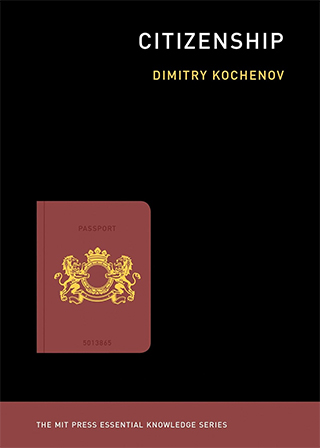
But few are as brutally determinative as the country in which we are born, argues Dimitry Kochenov. In his “Essential Knowledge” book, “Citizenship,” the Soviet-born Dutch legal scholar interrogates how the modern citizenship regime operates not merely as a legal framework but as an engine of global inequality that preserves a kind of “blood aristocracy.” International rules governing citizenship, he contends, constrain the potential of billions of people in the Global South by trapping them in their circumstances of birth, all while citizens of Western nations enjoy privileged access to healthcare, jobs, and international mobility. “Citizenship,” the author writes, “is never and has never been neutral.”
In the following interview, edited for length and clarity, Kochenov unpacks the debate around “open borders,” the murky realities of statelessness, and how citizenship has been weaponized in U.S. immigration policy. “If regular people don’t actually see the arbitrariness, the outrageousness, the inhumanity” of immigration enforcement, he says, “then they cannot have an open and informed conversation about the actual values of this society.” Increasingly, Kochenov adds, “Americans are learning about those values the hard way.”
When people think of the word “citizenship,” they probably imagine a set of rights and protections. Your book challenges that intuition dramatically — by arguing that citizenship is a system rooted in and perpetuating exclusion and hierarchy. How did you come to see citizenship this way?
Dimitry: Everything depends on who you are. If you lived your whole life in New York, you probably have no reason to think about citizenship critically. The critical angle only appears once you achieve a certain level of abstraction. So, for example, once you start crossing borders, once you start comparing. Without the vital element of comparison, there can be no talk of throwing this concept of citizenship down from its pedestal.
Once you start looking at things globally, citizenship is not what it seems. The law does not work in the same way for everybody. For example, you can vacation in the U.K., but most of the world’s population cannot dream of it because they know they will never obtain the necessary visa, as the U.K. is quite selective about whom it grants visas. Access only depends on one thing, essentially: your nationality.
Once you start looking at things globally, citizenship is not what it seems.
Citizenship was designed to fight the aristocracy. It started as a way to ensure that a random peasant — compared with a count who owns all the land — actually has a claim to equality under the law. Now, it is about preserving that aristocracy.
You have a good quote in the book that I think speaks to the thought-terminating nature of citizenship: “Citizenship is totalitarian in nature — it does not emerge in dialogue.” Is that to say the entire world is organized around an authoritarian concept that’s non-negotiable?
Dimitry: Absolutely. I stand by my quote. All this is distributed by blood. Some states act as if this is not true; they would instead say citizenship is about their “values.” But then there is actually research on values when you compare these countries’ constitutions, party majorities, and political programs. The values are roughly all the same: tolerance, dignity, human rights, free speech, rule of law, blah, blah, blah. So, the idea that borders are also correlated with any kind of value system is absurd, because then they wouldn’t actually draw the boundaries they are designed to draw.
Just like in feudal times, rights, duties, and glass ceilings are distributed in today’s world by blood, and citizenship is the core tool of such distribution. With less than 2 percent of the world’s population ever changing citizenship after birth, global non-blood-based transmission of citizenship is within the margin of statistical error. Crucially, birth distribution depends chiefly on bloodlines, even in ius soli jurisdictions: the majority of babies born in U.S. territory will have at least one U.S.-citizen parent anyway. The spatial, as opposed to class-based, nature of global inequality completes this picture: Where opportunity and rights are spatialized, citizenship of the U.S., France, or Japan is an aristocratic title, a blood-based key to global opportunity, while the majority of other citizenships in the world is the exact opposite: a rightless liability you cannot refuse.
Right. You can observe every American value in the book, know everything about American history, speak perfect English, and it still doesn’t make you a citizen…
Dimitry: Yes, you’ll be deported. ICE will come after you, and they will separate you from your children, who will be mistreated in some kind of cage. So much for “values.” In fact, that speaks more to the values of America, as well as to the values projected onto the population.
This is a tragedy in the contemporary world. We all say we have certain values, but then there is an asterisk: It doesn’t apply to the majority of humans, certainly not those who do not have the right color of passport, which our society has chosen. We are back to square one: blood aristocracy, which citizenship was originally designed to destroy. Someone who was born with an Afghan passport in Berlin and went to a Berlin public school and got a PhD in physics there — they will still not be entering the United States visa-free because they have an Afghan passport.
The other side of the same coin is that you often cannot renounce your citizenship by simply saying to your country of origin, “I don’t believe in your values. I would like something else.” In the majority of cases, citizenship never expires. This is something that can haunt you your whole life, your children, and the children of your children, because it also undermines the quality of any other passports or citizenships you might hold. The U.S. often will not let you enter if you also hold the citizenship of some “questionable” country.
The overwhelming majority of people in the world never change their citizenship, principally. This is the kind of thing that modern constitutionalism was supposed to supersede and overcome, but in fact it hasn’t.
You spend a significant portion of the book discussing statelessness, which might seem like a rare anomaly, but in reality, it affects millions of people worldwide. What are some of the most common ways people become stateless?
Dimitry: In general, international law would at least strive to prevent statelessness. But in practice, the group is growing. There are plenty of reasons for this: It can be a state secession that went wrong — for example, when Latvia left the Soviet Union. Or sometimes countries simply don’t care about basic principles of equality in international law. For instance, they might believe that women can create human beings, but at the same time, they cannot create citizens, especially if they don’t have the “right” husband. (Consider Lebanon and other places in the Middle East or Belgium until the end of the ’80s. There are still plenty of nationalities that cannot be transferred via women.) Or some countries might abuse their idea of “values” in order to maliciously deprive you of your nationality.
Last year, though, I published a paper arguing that statelessness as a concept is meaningless. And I will explain why: Statelessness in international law is when someone is not claimed by any public authority of any other state. It’s presumed that as a stateless person, you’re worse off than someone who has some citizenship. That might be true when comparing a stateless person in some horrible, dangerous place with someone who has citizenship in a desirable country. But in most cases, it doesn’t work that straightforwardly at all. Many “illegal” immigrants throw away their passports and lie about their origins because recognized statelessness puts them on a faster track to citizenship in the majority of cases. It also doesn’t transfer the stigma of their undesirable nationality to the next generation.
I want to pivot to the U.S. As you’ve already alluded to, immigration has been a defining political issue since the post-Trump era —
Dimitry: It started before that. The border walls appeared more than 10 years ago. What changed — and I apologize for jumping in — is that this immigration enforcement reached local communities. Suddenly, Minneapolis is the border. Suddenly, Boston is the border.

All this sorting of people based on their status is not something that is logically explainable within any established community, especially if it’s a democracy. This is not simply how we think. We don’t sort people by blood, closing our eyes to all the other factors, like education, wealth, beauty, you pick. But the border is only about blood, nothing else. When this border comes to your village and your township and starts sorting people precisely on that principle, everybody experiences it as a tragedy.
So, if you are demonstrating against ICE in Minneapolis, you are actually demonstrating against the main rule in global law governing the distribution of rights and duties in human population management, which is strictly enforced worldwide.
Do you think that the way that U.S. immigration enforcement has historically happened out of public view has constrained the national conversation around the issue?
Dimitry: Absolutely. If regular people don’t actually see the arbitrariness, the outrageousness, the inhumanity, and the demeaning exclusion based on no rational ground, then they cannot have an open and informed conversation about the actual values this society or any other is built on. Suddenly, Americans are learning about those values the hard way.
But also, America is not the worst example. I think the European Union is number one in terms of how harmful and how immigration enforcement is, when you consider deaths, kidnappings, and torture. Look at the 3,500 migrant children who have died over the past 10 years attempting to cross the Mediterranean for Italy, as well as the 34,000-plus migrants still missing today. In Europe, all this happens out of public view and is, essentially, fully legal through the creative use of legal techniques that I, with a co-author from Yale Law School, described as ‘EU Lawlessness Law.’
Open borders are often invoked, especially on the right, as a caricature of a completely rule-free global order. But what, in your mind, would a world with open borders actually look like in practical terms?
Dimitry: To me, the borders are already open. Like, when I show my Dutch passport at any border, I never encounter any obstacles. The majority of my friends — those who are citizens of the global aristocracy — never do either.
Which means that when we speak of “opening” or “closing” the borders, we only speak about people who are “not like us.” It only applies to, say, someone from the Central African Republic, or to someone from Bogota, or to someone from Algeria — not to a Frenchman and not to a guy from Tokyo. And this is what undermines the quality of the academic debate on this issue; they never make that disclaimer. They always pretend that the U.S. border is equally meaningful for a Mexican and for a Canadian.
This one-way-ness is actually just a cover-up for how wrong the starting point is. We should approach people as human beings rather than as citizens. Then, we might have a totally different conversation. We have to admit that blood is not the right proxy for security or any other kind of selection.
So, then, I guess the question is: What would be the more socially ideal way to sort people, to regulate who’s coming in and out, who can reside, who can work, etc., within that framework?
Dimitry: It’s an interesting question. Look at the European Union: Having non-discrimination on the basis of nationality as a starting point works.
Of course, you could say the E.U. consists merely of the richest countries, etc., and that’s true. But it’s also not true because, for example, Bulgaria’s GDP per capita is more than six times smaller than Ireland’s — it is a bigger discrepancy than that of Mexico and the U.S. So, to pretend that borders are meaningful and that opening them is dangerous, at least in the context of the E.U., is absolutely baseless.
If you suddenly start treating people as human beings based on the data they submit, you might discover that, actually, you can open the border for plenty of people and fine-tune the system along the way. They will not be overstaying. They will not be violating the objectives that states set for themselves. In fact, many states already review personal data beyond passports to determine who should be able to cross their borders, as more and more countries — the U.S., Australia, the U.K., and the Schengen Zone members now require pre-travel authorizations from all foreign travellers. Broader deployment of modern information technology could turn such screening into a much more effective tool than the good old passport color test.
I want to end on a question that’s a bit more personal. You grew up through the fall of the Soviet Union. How do you think that might have colored the way you think about citizenship from an early age?
Dimitry: I was lucky because it was a time when schools didn’t know what to teach. I didn’t receive what might be considered a “normal” indoctrination. You know, love your motherland. It was great that the U.S.S.R. was dissolving, but it’s not as though it suddenly disappeared.
I think the Olympic Games were in ’92, and by then, there was no Soviet Union. The team simply flew the Olympic flag. Who were those guys competing for? The simple answer was that nobody knew. Even those who were in charge of particular provinces or countries didn’t know.
We should approach people as human beings rather than as citizens.
Now, one or two generations after mine, all the indoctrination is back, in the worst kind of shape and form. So, this kind of window of statelessness — for me — was good in a sense, but also bad, because without police, crime runs rampant. And when the state is gone, law enforcement becomes crime. So, you start doubting the state much more. And when the states tell you a story — like America’s story about “values” — but then ICE comes, and they shoot random people, you remember: “Oh, I’m not surprised; this is what states do.”
You mentioned the Olympics, which calls to mind the recent fracas over Eileen Gu’s decision to compete for China rather than America in this year’s games. I can’t help but ask you what you thought about that situation.
Dimitry: It’s funny because in every Olympic Games, there have been plenty of these kinds of competitors. If you follow the media in the U.S., it will be one person; if you follow the French media, it will be another.
Normal human beings don’t fit into this neat globe where all the territories are marked. She stated in an interview that it’s difficult for Americans to understand that she is as Chinese as she is American. And for the Chinese, it’s also difficult. And it’s wrong.
You can fly whatever flag, but you cannot change what’s in your heart. It’s simply about how your brain is wired, how you go about different languages, spaces, and circumstances in life. And some people will be totally at home in seven countries, while others will only be at home in one.
Dimitry Kochenov is Professor at the Central European University in Vienna and Budapest, and also teaches at LUISS Guido Carli in Rome and Peking University School of Transnational Law in Shenzhen. He has served as a consultant for governments, law firms, and international institutions, including the Maltese Republic, the Kingdom of the Netherlands, and the European Parliament. He is the author of “Citizenship.”