I Know the Cost of Indecision in Abortion Care. Dobbs Made It Worse.

In June 2022, when the Supreme Court overturned Roe v. Wade, eliminating America’s constitutional right to an abortion, there was no question that patients would eventually die as a result of the ruling. Less clear was who, where, and under what circumstances. A pregnant person with cancer? Someone facing severe preeclampsia or hemorrhaging after an abruption? In the end, the first true death dealt by the impact of Dobbs still is — and may remain — unknown.
Yet the tragic consequences of the ruling have been no mystery. In September 2024, ProPublica reported the death of Amber Thurman, a 28-year-old Georgia woman who presented with a uterine infection requiring a dilation and curettage (D&C) procedure, which is often used to treat abnormal bleeding following a miscarriage. She was a single mother recently enrolled in nursing school who was seeking an abortion after an unintended pregnancy. Because the procedure was already illegal in Georgia, she drove to North Carolina instead, waking up at 4 a.m. for the long trip. Due to traffic, she arrived at the clinic a mere 15 minutes late and was thus denied the procedure. She was provided with medication abortion instead, the process to be completed back in Georgia.
Complications such as incomplete tissue passage and uterine infections are uncommon after medication abortion. When they do occur, they are almost always resolved safely — often through a D&C procedure — given that the patient can legally access care. Amber Thurman, however, never accessed the care she needed. She later presented to the Piedmont Henry Hospital Emergency Department in the suburbs outside of Atlanta with bleeding. Fetal tissue had remained in her uterus, causing an infection. Thurman needed a D&C procedure, but instead sat in a waiting room for 20 hours. When doctors eventually performed a D&C, her heart stopped during surgery.
In many ways, Thurman’s horrific story parallels that of Porsha Ngumezi, another patient who bled to death under similar circumstances in Houston. Both were in early pregnancy; both required a D&C to save their life; both sat in emergency departments instead, deteriorating until they ultimately descended far into critical illness. And, of course, both should also be alive with their children today.
Why did they not receive a D&C? In neither case have the hospitals or physicians provided detailed responses; likewise, without complete information, one can only speculate about the motivations or internal thought processes of those involved. We don’t know what did or did not occur behind the scenes. Medical care is not generally the act of a single individual but the collective efforts of many people in many roles, any one of whom can potentially stop the line if they raise concerns. In recent years, hospitals have, correctly, moved away from purely hierarchical structures to ones in which all employees are empowered to provide input and recommend changes. This restructuring improves patient safety and helps decrease medical error, though it also risks delays due to disagreement.
But there could have been another factor at play, too. It is a phenomenon that has plagued the medical profession since the very beginning — and that will likely spell more preventable death and despair in the wake of Dobbs.
Decision paralysis: Every physician, at some point in their career, has probably experienced it. It’s a state of mind you often don’t realize you are in at the moment. You believe, instead, that you are simply pondering a clinical question, awaiting more data, and ideating rather than stagnating. The paralysis is obvious in retrospect. But at the moment, you have to pull yourself out. Physicians need to make decisions.
I learned this lesson while on shift in a trauma bay many years ago during my training. One day, a Jane Doe arrived with a stab wound in her chest. The patient was found unresponsive with no identification, no one who knew her, and she had no medical or obstetric records on file. All we could tell was that she appeared pregnant, though far from term. She was unconscious and intubated, blood bubbling about the endotracheal tube protruding from her mouth. While the trauma team descended upon her head and chest, we in obstetrics worked first to determine her gestational age. If the fetus was sufficiently mature to survive after delivery — at that time, 24 weeks — then if she worsened, we might desperately perform what we call a “perimortem” cesarean, or one performed as the parent is about to die.
All I had was two centimeters, a dying patient, and a team awaiting direction. I just stared and stared and stared.
Back then, we would or would not perform perimortem cesareans based partly on the developmental stage of the fetus. Modern practice has come to recognize that cesareans at more than 20 weeks may improve rather than worsen survival outcomes in cardiac arrest, independent of neonatal survival. In fact, such deliveries are increasingly referred to as “resuscitative cesareans,” emphasizing the primary intent of parental benefit.
An ultrasound was available in the trauma unit, though it was not specifically configured for obstetrics. I used the machine to start scanning and noticed the patient’s fetus was still moving with cardiac activity, though it was obviously premature. But how premature? The obstetric machines are programmed so that when you measure anything — head, abdomen, or femur — an estimated gestational age appears. However, the trauma ultrasound only showed centimeters, with no estimate. At that moment, I struggled to visualize anything at all. The lights overhead brightened rather than darkened, and the keypad became unfamiliar as surgeons and nurses shouted back and forth.
Then the patient’s heart stopped beating.
We commenced chest compressions with only minutes left to perform or not perform a perimortem cesarean. Finally, a femur appeared on the ultrasound: two centimeters long. Now I had a number, but which gestational age did it correspond to? If above 24 weeks, a perimortem cesarean could be performed. But if under 24 weeks, it was better to just allow the surgeons to work on the patient unimpeded. I pondered desperately. The team, in the meantime, had assembled the surgical tray with Betadine and a scalpel. If I could freeze time, I would have carefully recorded every measurement and precisely determined the gestational weeks. But all I had instead was two centimeters, a dying patient, and a team awaiting direction. I just stared and stared and stared.
“Are you doing a cesarean or not?” a resident yelled, pulling me out of the hypnosis into which I had fallen.
“No,” I said, closing my hand. “She’s too premature. Just do everything you can to save her.”
The trauma surgeon nodded. I wiped the ultrasound gel from her abdomen, and as I then stood watching, I can say with certainty they did everything they could.
What should patients do if they are concerned their physicians are lost in indecision?
The simplest approach is to ask direct questions about their care: Why is a procedure being performed, or why not? If not performed, what would the reason for the procedure be? What future clinical changes would then trigger reconsideration? When undecided, physicians often gain clarity by speaking aloud; a situation becomes clear when we hear ourselves talk or have to justify a decision, the act of explanation itself often breaking the spell. But as the patient, you also need the exact picture, a plain understanding of rationale and next steps. You need to know whether you are endangered, whether you should find another hospital, or whether you should seek care in another state entirely. You need to know if now is the time to fight for your life.
This imperative becomes particularly challenging in states with severe abortion restrictions. A pregnant patient with, say, severe preeclampsia, bleeding, or prematurely ruptured membranes should ask if an abortion would be offered and receive a straightforward answer. However, in states with severe abortion restrictions, a doctor may be reluctant to disclose that the previous standard of care cannot be legally or administratively provided. In this instance, a doctor might decide not to assume criminal risks and is now struggling with shame.
Abortion bans have cataclysmically changed our field, though they should also not alter a physician’s fundamental calculus.
Alternatively, a physician may fiercely advocate for a necessary procedure, putting their own professional neck on the line. But instead of being able to act decisively, they must keep appealing upward through legal and administrative layers. The doctor may understand that process as progress — but, in actuality, time is running out, with the patient descending further into sepsis or hemorrhage.
Of course, no physician can make the right decision at the right time, every time — and in some cases, careful deliberation is warranted. But doctors like me already have enough to weigh when providing life-saving care to patients. Add the threat of criminal prosecution to the list, and unnecessary hesitation becomes far more likely — with major consequences borne by the patient. Nevertheless, the physician’s responsibility to make medical decisions remains unchanged.
In the immediate aftermath of Dobbs, the medical community faced clinical uncertainty under laws with vague criminal penalties. We found ourselves in fraught situations with unclear options. But as doctors, we all make stressful decisions with health in the balance as part of our jobs. This was true before Dobbs and remains true after.
Abortion bans have cataclysmically changed our field, though they should also not alter a physician’s fundamental calculus. Be it trauma or cancer or reproductive health, the clock is always ticking, time always running out, and doctors must make the choices that are best for their patients.
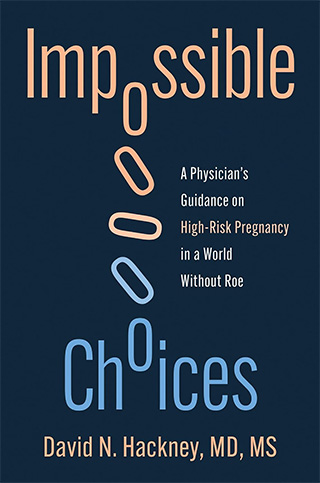
David N. Hackney, MD, MS, is Professor of Reproductive Biology at Case Western Reserve University and Division Chief of Maternal Fetal Medicine. He is currently District Legislative Chair of the American College of Obstetricians and Gynecologists and was the Section Chair for Ohio at the time of the Dobbs decision. He is the author of “Impossible Choices,” from which this article is adapted. The views expressed are his own and do not represent those of any organization with which he is affiliated.