Why Human Giants Defy the Laws of Physics
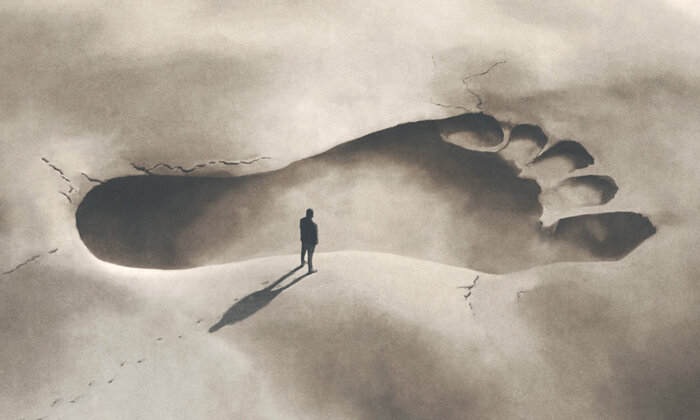
According to legend, giants once roamed the Earth. In Homer’s “Odyssey,” Odysseus encounters the Cyclops, the one-eyed son of Poseidon, living in a huge cavern, hungry and angry. He grasps men and sheep in one hand, devouring them whole. In the days of King Arthur, a clever young boy earned the title of “Jack the Giant Killer,” using his sharp wit to outsmart and slay the various “giants” plaguing the land. Another Jack — or perhaps it is the same Jack — famously plants some magic beans and climbs the resulting beanstalk to a castle in the clouds, cleverly outwitting the giant residing there.
All these giants of legend have a humanoid form, and they undertake generally human activities — walking, stomping, dancing, carrying heavy loads, running, and so forth. They act and move about in a human manner, only at a larger scale. But if human giants did exist, could they actually survive in this form?
In his foundational 1638 text “Dialogues Concerning Two New Sciences,” Galileo Galilei argues that this folklore understanding of the nature of giants is fundamentally flawed. He contends that this idea of a massive humanlike creature is, quite simply, physically impossible.
To begin his argument, Galileo asks us to imagine a structural beam of sturdy oak. The beam might be used to support a heavy load — perhaps a load of bricks or a great stone.

He then asks us to imagine a much larger oak beam, scaled up in size but with the same proportions and material. A thicker, solid oak beam, of course, will naturally support more than a slender beam of the same wood. But how much more can it support? Will the larger beam be able to support the same load, but also scaled up in size? Should we expect the larger beam to support a scaled-up load of bricks or a scaled-up stone?

Galileo ingeniously argues no — the larger beam will not support a similarly scaled-up load. Indeed, he claims that at a certain sufficient scale, the beam will no longer support even its own weight! His argument relies on a certain subtle observation concerning how scaling works in different dimensions.
Galileo first observes that the load-bearing strength of a beam depends on its cross-sectional area, since a failure of the beam involves it breaking across a cross section. Since area scales as the square of the linear factor, a 10-times larger beam — with length, width, and depth each scaled by a factor of 10 — will have a cross-sectional area 100 times larger than before. In other words, a 10-times larger beam is 100 times stronger! It will be able to support 100 times the load as the smaller beam.
That may seem initially very good. But the problem is that the weight of the load, for a given material density, is determined by its volume, and volume scales with the cube of the linear factor. Scaling up a load of bricks or a great stone by a linear factor of 10, therefore, will cause a 1,000-fold increase in the volume — a 10-times larger stone weighs 1,000 times more.
Galileo brings these observations to their natural collision. A 10-times-larger beam is 100 times stronger, yes, but the similarly scaled-up load became 1,000 times heavier. If the smaller beam had been carrying the optimal load, therefore, then the scaled-up beam would not be able to support the scaled-up load — not even close! It would support only one-tenth of it. Galileo argues that any given beam will have a certain sufficiently scaled-up size at which it will no longer support even its own weight. The strength of the beam scales with the square, but the mass of the beam itself scales with the cube, so at a sufficient scale, the beam will simply be too heavy for its own strength.
Now back to giants. Picture the bones of a giant serving, in effect, as structural “beams” supporting its body mass, its flesh, and muscles. If the giant’s bones are made of the same stuff as ordinary men, his strength has not scaled the same as his mass.
The conclusion, Galileo writes, is catastrophic for the giant:
Clearly then if one wishes to maintain in a great giant the same proportion of limb as that found in an ordinary man he must either find a harder and stronger material for making the bones, or he must admit a diminution of strength in comparison with men of medium stature; for if his height be increased inordinately he will fall and be crushed under his own weight.
Similarly, scaled-up versions of wooden ladders would not support a scaled-up giant human climbing them; scaled-up swords would be too heavy for such giants to lift; scaled-up armor would be too heavy to wear; scaled-up wooden houses would not support their own roofs; a scaled-up wooden chair would not support even itself, let alone a giant sitting in it; and scaled-up dining glasses would be too weak to hold the volume of wine or water within them. In short, the entire world of giants as pictured in folklore does not fully make physical sense.
While Galileo’s argument explains the nonexistence of human giants, it also explains the existence of nature. Namely, of animals such as hippopotamuses, rhinoceroses, elephants, and dinosaurs, which tend (or tended) to be stocky, with proportionally thicker, sturdier bones than smaller animals.
Elephants, for example, have much thicker legs relative to their size than do dogs and cats. This is explained by Galileo’s observation that the strength of bones scales with the square of the linear scale, since it depends on the cross-sectional area of the bones (and perhaps the pulling strength of muscles also depends on cross-sectional area), but the weight of the animal scales with the cube. So, the bones themselves need to become proportionally thicker to support the increased weight.
A dual effect occurs when scaling down in size. Very small animals, for example, are typically slender and lithe. Insects tend to have relatively thin limbs, which would be entirely inadequate to support the animal if scaled up proportionally to a much larger size. Unlike humans, small insects can often jump many times their own height. Insects can walk on walls and ceilings — they weigh so little, in fact, that electrostatic forces are strong enough to hold them fast to the surface.
If one were to encounter a fly that was 10-times normal size, but with the same proportions and body design, it would weigh 1,000 times as much, and the tiny electrostatic forces would be insufficient to allow it to stick to walls. It would certainly not be able to fly, and probably it could not even support itself standing on those toothpick legs. Water bugs can walk on the surface of water, because at that scale, the surface tension of the water is proportionally strong enough to support the meager mass, but larger bugs would be too heavy. The laws of physics and the basic nature of chemical and physical reality simply do not scale uniformly with size.
Galileo’s paradox applies just as much to the folklore conception of the miniature human, such as with the Lilliputians or the Hollywood films “Downsizing,” “Ant-Man,” or “Honey, I Shrunk the Kids!” The Lilliputians of “Gulliver’s Travels,” for instance, are about six inches tall, and the bones of such a 10-times scaled-down human would be 100 times weaker, while weighing 1,000 times less. Such a person would therefore not walk about normally but could probably jump very high (relative to his or her height) and carry correspondingly huge loads. For example, at normal size, a human can often carry another human on his or her back, but not much more. But the one-tenth-size humans, as Galileo notes, would be able to carry much more:
Whereas, if the size of a body be diminished, the strength of that body is not diminished in the same proportion; indeed the smaller the body the greater its relative strength. Thus a small dog could probably carry on his back two or three dogs of his own size; but I believe that a horse could not carry even one of his own size.
Meanwhile, however, the tiny humans would find themselves subject to all manner of forces that are more prominent at small scale. They would stick to walls and other things more easily because of the electrostatic forces, and water would be a big problem, seeming much stickier at small scale. In short, the folklore vision of Lilliputians or other tiny humans walking about as humans ordinarily do is fundamentally flawed and ultimately just as physically impossible as giants are.
Galileo’s observations enable us to see easily how evolutionary forces might work on body size. Perhaps for some organisms, there are comparatively few genes that control the overall body size in such a way that the typical size of an animal will be subject to evolutionary forces of natural selection.
We have clear evidence of species of animals greatly changing in size over evolutionary time scales. Early mammals were very small. For example, horses used to be about the size of small dogs — and a vestige of this can be seen today in the miniature horse breeds. Many insects, by contrast, were larger. Before dinosaurs and birds, dragonflies had wingspans of several feet, while we’ve found fossils of cockroaches up to four inches long. But the body shapes are not simply scaled exactly up and down. Evolutionary forces have acted on these body-size plans over time to improve survival, performing an optimizing arbitrage for the comparative advantages available in each size.
Galileo glimpsed a subtle, secret aspect of our physical existence: He perceived the core dimensional nature of important features such as strength and mass, realizing as a purely mathematical consequence that these features will therefore scale differently in those different dimensions. So despite the enormous range of sizes available in the physical universe, our lives would not be the same at a different scale. Giants are impossible. The Lilliputians are to be found only in literature. And as for humans, there is a very good reason we are the size we are.
Joel David Hamkins is a mathematician and philosopher who investigates the mathematics and philosophy of the infinite. He is the O’Hara Professor of Logic at the University of Notre Dame, having previous affiliations with the University of Oxford and the City University of New York. He is the author of numerous textbooks, including “The Book of Infinity,” from which this article is adapted.