Squid Theater
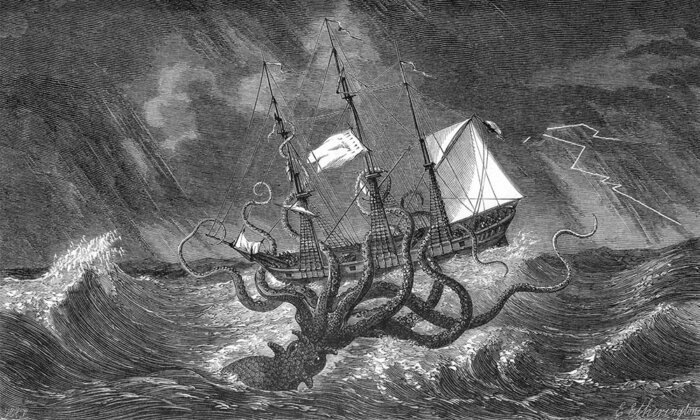
Man gazes at squid, and squid gazes back. Between the two lies the window of the Nautilus submarine, separating the environments of water and air, and also acting as a kind of mirror, throwing into relief the similarity between the two beings. The man, the harpooner Ned Land, has his arms calmly folded, but the squid will win any contest involving arms. A large book, presumably some kind of work of natural history, lies open on the windowsill, perhaps as an aid to identification. But the book shows only the creatures of natural history, whereas the squid, it turns out, has many other roles.
William Firebrace is the author of “Memo for Nemo,” from which this article is adapted.
This squid–human confrontation, shown in a woodcut in the first French edition of “Twenty Thousand Leagues Under the Sea,” is the definitive encounter in the novel, the representatives of the sea and of the land meeting on roughly equal terms. The man can clearly see the squid and assumes, perhaps wrongly, that he can identify the creature. But what does the squid see with its great eyes, adapted to distinguish the faintest light in the darkness? Some kind of inert alien object arriving unexpectedly in its environment? Unusual creatures, predators or prey? A vague glow? A circle of light? Perhaps the squid’s system of perception is so very different from ours that words like seeing and understanding have little meaning. The squid’s cousin, the octopus, can see with its skin, which contains light-sensitive chromatophores similar to those found in its eyes. The squid’s skin may also be light-sensitive, its entire method of seeing very different from a creature of the land. We don’t know what its diffused gaze conveys, and can only wonder if it is something like our own.
The creature in the woodcut is, in fact, more octopus than squid, with eight rather than 10 tentacles and an octopus-like head. The two species come under the class cephalopod (from the Greek, head-foot), an octopus basically being a bag-like head with a ring of arms, while a squid is spindle-shaped, with arms at one end and tail at the other. For the purposes of this narrative, they are considered variants on a theme, even if such a rash sifting together is alien to marine biologists. The sequence of illustrations in the novel charts the rapid deterioration of the squid–submariner relationship. Aronnax launches into a long description of the zoological background to cephalopods. Nemo appears and announces that there are actually seven giant squid threatening the submarine, and he is prepared to engage them in hand-to-hand combat. The grappling axes are broken out, the submarine surfaces, hatches are opened, and the tussle begins.
In the second engraving, the captain is battling a tentacle, dripping with slimy mucus, that writhes down the stairway for the hatch; the squid has begun to enter the machine. Two pages later, the third engraving shows the squid in the foreground, one of its tentacles clamped around a sailor, numerous other tentacles waving in the background as the crew hacks away with axes — to no avail: the sailor is devoured. The short piece of text under this third image states “le poulpe brandissait sa victime comme une plume,” plume being either a feather or a pen, a reminder even in this desperate battle that the captain uses black squid ink to write his memoirs and that the squid, it seems, may also have their equivalent way of using humans to inscribe their thoughts. By now, around a dozen squid have invaded the deck, which is awash with blood and black ink. Ned Land — seized, but saved by the captain — plunges his harpoon into the triple heart of the monster. The other squid recognise that the game is lost and withdraw; Nemo stands covered in blood and weeps for his lost companion. For the moment, there is no great communication between the different sides of the window.
When Verne first published his novel in 1870, the creatures of the sea were mostly considered as food and raw materials to be harvested for human gain. In this spirit, his protagonist Nemo uses the undersea as a vast larder from which he selects whatever he desires. Squid are served up, with appropriate garnishes, to Nemo and Aronnax in the formal dining room of the submarine. Squid are also, without any evidence, defined as inherently hostile creatures, potentially dangerous to man. However lonesome life in the Nautilus might have been, the idea of communicating with squid would therefore have seemed highly unlikely: Humans still belonged to a separate order. Only in fairy tales, where fishermen sometimes encounter talkative fish, is there much conversation between men and sea creatures. Unlike the dolphins and cetaceans of Marineland, non-mammals such as the giant squid have, at least until very recently, had no scientists attempting communication with them, no recording contracts for their songs, no star turns in front of crowds of spectators. But still, squid do have their own relationship with humans, their own soft intelligence, culture, and philosophy, as well as their own occasional links to outer space.
We don’t know what its diffused gaze conveys.
Cephalopod–human crossovers can be found throughout history. The mythical Scylla, described by classical authors from Homer on, was a beautiful sea nymph transformed into a monster, with a large number of tentacles, six heads on snaky necks, and a waist circled with baying dogs’ heads — an ambitious combination of the serpentine, canine, and cephalopod. There is something rather mournful about the Scylla, a monster even to herself. In medieval times, the hybrid became more sophisticated. In 1433, a so-called bishop-fish, dressed in mitre and robe, was caught off the coast of Poland, presented to the King of Poland, conversed for a while with various actual bishops, and then returned to the sea, where it performed the sign of the cross before disappearing. It seems likely that the mitre-like form of a squid’s cowl and robe-like tentacles might have caused the misidentification. Similar bishop-fish were later caught off the coasts of Denmark and Germany. Compared to the classical Scylla, the medieval squid–human was clearly a being of quality, able to converse with men on equal terms.
The tradition of the Scylla continues on the margins of historical maps, where giant squid or krakens are shown attacking sailing ships, their long arms pulling the vessels down beneath the waves. While the blank spaces of the unknown oceans spawned many sea monsters with unlikely anatomies and unpronounceable names Architeuthis, Apidochelone, Iku-Tursu, Jürmunganr, Mokèlé-Mbèmbé, Qalupalik, Umibōzu, and their various terrifying relations — the giant squid is the only one to have survived the relentless scientific investigation and categorisation of the ocean’s fauna and gradually mutated into something resembling a real creature, an accepted part of natural history. In this sense, the giant squid’s grand entrance in literature, its climactic encounter with the Nautilus, was long overdue. In Alfred Tennyson’s sonnet “The Kraken” (1830), the creature lurks backstage, awaiting its moment of appearance:
Below the thunders of the upper deep;
Far, far beneath in the abysmal sea,
His ancient, dreamless, uninvaded sleep
The Kraken sleepeth: faintest sunlights flee
About his shadowy sides: above him swell
Huge sponges of millennial growth and height;
And far away into the sickly light,
From many a wondrous grot and secret cell
Unnumbered and enormous polypi
Winnow with giant arms the slumbering green.
There hath he lain for ages and will lie
Battening upon huge sea-worms in his sleep,
Until the latter fire shall heat the deep;
Then once by man and angels to be seen,
In roaring he shall rise and on the surface die.
The kraken originates in Nordic myths, but was also accepted by the Swedish naturalist Carl Linnaeus, who included it in his taxonomy of all living creatures, the “Systema Naturae” (1735), where it hovers contentedly enough between legend and science. Tennyson’s creature inhabits the deep, a sign of the gradual realisation in the mid-19th century that the earth and its oceans were much older than had been presumed, and might still contain creatures more ancient than mankind. In the poem, the kraken only finally awakens and rises to the surface to signal the end of time, to encounter mankind, and to die: The legend cannot survive a close encounter either with the surface or with humans.
A rather more believable but still poetic deep-sea creature is sighted in a wonderful passage in Herman Melville’s “Moby Dick”:
In the distance, a great white mass lazily rose, and rising higher and higher, and disentangling itself from the azure, at last gleamed before our prow like a snow-slide, new slid from the hills. Thus glistening for a moment, as slowly it subsided, and sank. Then once more arose, and silently gleamed … a vast pulpy mass, furlongs in length and breadth, of a glancing cream-colour, lay floating on the water, innumerable long arms radiating from its centre, and curling and twisting like a nest of anacondas, as if blindly to catch at any hapless object within reach. No perceptible face or front did it have; no conceivable token of either sensation or instinct; but undulated there on the billows, an unearthly, formless, chance-like apparition of life.
Melville’s — as-yet-unidentified — giant squid is a mysterious creature, a rival to the great white whale that the Pequod is really pursuing. Unearthly, not only because it belongs to the water, but also because it seemingly comes from somewhere other than planet Earth. Formless, because it has no fixed anatomy. Chance-like, because it is never seen when sought. All these words suggest some kind of undefinable other, an alternative to recognisable creatures like whales, which were valued for their oil and were therefore hunted almost to extinction, while the supposedly worthless squid were left in peace in the depths.
The quality of formlessness, as l’informe, would be adopted in the 1920s by certain theorists such as Georges Bataille, who, in a brief article in the surrealist journal “Documents,” proposed formlessness as an alternative to the relentless taxonomies of the world, an escape from the straitjacket of fixed definitions. The term was taken up later in the 1990s by art critics such as Rosalind Krauss, who saw l’informe as a way of thinking about aesthetics. In the first meaning of l’informe one would consider the squid as formless because it is outside the categories of natural history, outside the taxonomies proposed by Aronnax, moving from monster to bishop to lover to performer. In the second, its interest lies in the fact that it has no fixed shape. But is the squid formless? Melville’s description suggests so, because it is seen from above, as part of the waters, but an actual squid does have form, even if it is soft and without a skeleton.
One of the first fictional encounters with a giant cephalopod — and one that established the pattern for a whole series of violent meetings between man and sea-beast — occurs in Victor Hugo’s novel “The Toilers of the Sea.” A shipwrecked sailor comes face to face with a monster octopus in a cave on the isle of Guernsey, a place not normally renowned for oversized sea creatures. A long struggle ensues between sailor and beast, the man eventually coming out on top. Hugo elevates the beast to a mythical size and stresses its evil nature. He also locates the creature in a variable taxonomy. It is variously described as “a bundle of rags,” “a rolled up umbrella,” “a hydra,” “a wheel,” “a beast made of cinders,” “an illness disguised as a monster,” “a pneumatic machine,” and a “sensitive dragon.” Crucially, it is “horribly soft and yielding,” having no form and thus ungraspable, either physically or conceptually. With this wild variety of descriptions, it clearly comes under the Bataille category of l’informe, both in the sense of being formless and also through its slippery ontology. Already, on one of its first appearances, it refuses to take any specific role.
Before being summoned to account by art theorists, the giant cephalopod would continue to undergo various transformations in its relationship to man, fiction overlapping with fact. In “The Call of Cthulhu” (1928), H.P. Lovecraft created a series of horror stories based on a vast, semi-divine, cephalopod-like creature living in an undersea city called R’lyeh. A relic of an alien culture from outer space, Cthulhu has a squid- or possibly octopus-like head with tentacles, but also wings and claws. Unsurprisingly, the creature inspires the devotion of cults from the southern United States, who summon it from the depths with the rather unpronounceable incantation “Ph’nglui mglw’nafh Cthulhu R’lyeh wgah’nagl fhtagn,” helpfully translated as “In his house at R’lyeh, dead Cthulhu waits dreaming.”
Lovecraft describes how the city of R’lyeh rises to the surface and then sinks beneath the waters, its construction “abnormal, non-Euclidean and loathsomely redolent of spheres and dimensions apart from ours” — possibly an early teuthid version of deconstructive architecture. In later stories, he credits the alien squid race with the construction of large-scale Atlantis-like cities, clearly unimpeded by the problems that beset George Bond and Jacques Cousteau in their attempts to build undersea habitats.
The giant squid has more specifically British forms. John Wyndham’s “The Kraken Wakes” (1953) again features aliens that can thrive in the deep sea, having evolved in a high-pressure atmosphere. In 1950s monster mode, the krakens attempt to take over the planet, sinking ships, harvesting the land by taking humans from coastal areas, and melting the icecaps to flood low-lying cities. It is the Japanese who come to the rescue, using an ultrasonic weapon to dispatch the creatures. An adapted version of the Lovecraft cephalopod — “a monster of vaguely anthropoid outline, but with an octopus-like head whose face was a mass of feelers” — would later pop up in “The Pirates of the Caribbean” film series, with Bill Nighy as a Davy Jones character with a face constructed of tentacles, like a thick beard, only more dextrous, able to handle objects and even smoke a pipe. The Nighy figure also has a tentacle for an index finger and a Scottish accent. He is the reverse of the Scylla, with the head of a cephalopod but the body of a human.
A more recent work, China Miéville’s novel “Kraken” (2010), restores the giant squid to its status of divinity. The teuthid-worshipping cult of the Church of Kraken Almighty, by an unexpected and not fully explained process of object size reduction, removes a giant squid preserved in formaldehyde from the Darwin Institute of the Natural History Museum and transfers it to a church in South London. This squid is an uncommunicative god, unresponsive to the devotion of its worshippers, all the more holy in its detachment from everyday London life. Compared to Lovecraft, “Kraken” offers a very British take on the arrival of the unknown creature from the sea, a gentle threat with contemporary overtones of fashionable London society.
Cephalopods continue to change identity according to the period in which they appear, but keep their qualities of being both humanoid and other. Paralleling and intersecting the undersea documentaries of the 1950s and 1960s were a series of B-movies in which large-scale deep-sea creatures emerged into the limelight from the scriptwriter’s imagination, with varying degrees of credibility. Mostly these monsters suffer from mutation due to radiation, or have been mistakenly awoken after a long, deep hibernation, or have simply remained undetected for many millions of years, awaiting their moment to emerge.
The legend cannot survive a close encounter either with the surface or with humans.
In this new development, octopuses at first find more favour than squid. In “The Beast from 10,000 Fathoms” (1952) — mainly concerned with a dinosaur marauding cheerfully through Manhattan, full of atomic vim — there is a scene where a professor and pilot descend into a marine trench in a Barton-inspired bathysphere and witness a struggle between a shark and a giant squid, unaware of their own imminent fatal encounter with the dinosaur. This was a few years after Otis Barton had made his record-breaking solo descent in the benthoscope in the Pacific. “The Monster from the Ocean Floor” (1954) is revealed to be a giant octopus off the coast of Mexico, while “It Came from Beneath the Sea” (1955) has another overweight octopus, created in stop-motion by Ray Harryhausen, once again disturbed by atomic testing, threatening the coast of California and attacking the Golden Gate Bridge, the first cinematic encounter between cephalopods and architecture. Giant cephalopods flicker in and out of various subsequent films, usually as hostile monsters emerging from an alien environment and needing to be eradicated. Particularly attractive for filmmakers is the way that these squid and octopuses are quasi-humanoid; their tentacles imitate arms and legs, they can seize large objects, and occasionally even move around out of the water.
These are just B-movies, intended for fun, but these creatures also suggest something beyond being narrative devices. What do they represent? Fears about the political enemy, the communist world, living in an insidious environment which is both close at hand and potentially dangerous? Concerns about nature itself, now out of control after long being ignored? Like Tennyson’s kraken, an end to a certain kind of time, marked by the death of the beast? Or perhaps something more subtle, some other previously repressed side of civilised 1950s mankind, which awakens in the waters of the oceans, from which we have long ago escaped, some part of our liquid past?
Amidst this plethora of violent yet possibly misunderstood cephalopods, there has always been another approach. What if cephalopods weren’t evil, but attractive, even erotic? Japanese prints often show pearl-divers gazing down into the sea, sometimes meditatively as though peering into their own subconscious, sometimes with violent erotic scenes, hoped for or feared, occurring beneath the waves. A famous and disturbing early-19th-century Hokusai print shows a giant octopus pleasuring a female pearl diver, while a smaller octopus occupies himself with her face, apparently to the satisfaction of all concerned. “With the sucker, with the sucker!” runs the overstimulated text, “yoyoyooh, saa … hicha hicha gucha gucha, yuchyuu chyu guzu guzu suu suuu.”
The image conveys an absurd eroticism, but there is something alluring in that soft flesh. J-K Huysmans, inventor of the des Esseintes aquarium, described the “almost superhuman expression of agony and sorrow — which convulses this long, graceful female figure with aquiline nose — and the hysterical joy — which emanates at the same time from her forehead, from those eyes closed as in death.” The mood of the image is uncertain, cartoonish, erotic, violent, macho, or feminist. Later, the whole genre would develop into the cartoons and animations of contemporary Japanese tentacle erotica, which continues with more dubious enthusiasm to show every orifice of the human anatomy pierced by tentacles and suckers. In “Spaghetti Nero” (2007), the German photographer Jürgen Teller played with the same ideas, portraying Björk as a vampiric devourer of squid, with strings of black pasta hanging from her mouth like tentacles, and in “Octopus on a Bed” (2008) he showed an octopus on a hotel bed, as potential erotic partner or sex toy, with its rows of tentacular suckers part alluring, part repulsive. Elsewhere, the title of the Bond film “Octopussy” (1983) speaks for itself.
The unusual, almost human, behaviour of the octopus is also revealed in Jean Painlevé’s short films “La pieuvre” (1928) and the later “Amours de la pieuvre” (1965), made at the time when B-movies were portraying the cephalopod as purely evil, but which both show the grace of a bulky octopus as it moves underwater, and the tenderness with which they touch each other with their tentacles when they mate. Cousteau’s film “Pieuvre, petite pieuvre” (1972), shot around Marseille, shows a diver wearing an aqualung swimming together with an octopus. In scenes reminiscent of the underwater shots in “The Creature from the Black Lagoon,” the two move in time with one another, almost a mating dance, the diver in his black suit and yellow mask, the octopus with its extraordinary tentacles, curling around one another, the first indication that there might be some sympathy between human and cephalopod. “The absence of a skeleton in a marine life-form,” Cousteau wrote in “Octopus and Squid: The Soft Intelligence,”
is a form of perfection … cephalopods live in another world. I mean not only that they live in the sea, which is now open to exploration by human beings, but also that they inhabit a world of sensations and perceptions that is not our own. The evolutionary path taken by cephalopods to a high degree of perfection is not that taken by the human race. It is nevertheless parallel to ours and may lead them further still.
Soft intelligence was presented by Cousteau as being very different from the hard intelligence of humans; for him, it suggested an alternative approach to living in the sea. Although his opinions were rejected by many scientists as anthropomorphic wishful thinking, Cousteau himself was changed by such soft encounters. By the early 1970s, he was no longer merely the colonizer of the seas but had come to realise that the oceans and their creatures were much more complex than he had at first thought and that inhabiting the sea implied learning from those who already lived there. Following on from Cousteau’s more positive view of the cephalopod, Tomi Ungerer’s amiable cartoon octopus “Emile” (1960) shows itself to be a friend of the human race, more human than humans, rescuing drowning children on the beach and capable of numerous metamorphoses, posing in turn as chair, sledge, car, bull and bird, a creature of boundless flexibility.
Little is known of cephalopods “other than as ornaments or how they taste as calamari or sushi,” Sylvia Earle writes in “Ocean, An Illustrated Atlas” (2009). She describes her descent into the seas off Hawaii and her encounter with a large cephalopod that clung to her submersible. Now the meeting of human and cephalopod is no longer antagonistic:
From my perch in the depths, watching the silvery red creature swim towards me, I realised I was being inspected not by a squid but an octopus. Eight not ten arms reached out to touch the mechanical arms of the sub, revealing a sheltered cluster of pale eggs.
Earle comments on how such cephalopods have “eyes hauntingly structured like those of mammals, with complex signalling systems using flashes of colour, shapes and bioluminescence.” She portrays her encounter with the giant octopus as the crossing of the gaze of two creatures from very different environments, carefully sounding each other out: “Seeing a creature unlike any I had ever seen before, knowing she had never seen a creature such as I, inspired in me a sense of wonder and hope.”
The giant squid remains elusive. Giant squid beaks have been found in the stomachs of whales, and the marks of squid suckers have been seen on their skin. Occasionally, great masses of identified flesh have been washed up on seashores, to the confusion of marine biologists. A seven-meter-long giant squid, caught by fishermen off the coast of New Zealand in 2005, is now preserved within the world’s largest man-made block of ice in the Melbourne Aquarium. The body of a colossal squid — a second, even larger species that can reach over 10 meters — is in the Te Papa Tongarewa museum in Wellington, caught, frozen, thawed out, and now preserved in propylene glycol.
But the Te Papa Tongarewa vitrine and the Melbourne block of ice contain not a giant or a colossal squid, but the mangled corpse of a once extraordinary creature, bereft of everything that made it wonderful — its movement, its sentience, its illumination, its habits, its life; what one might call its squidishness. The squid, whether giant or colossal, cannot be preserved; it can only ever exist in its environment, and since we cannot go there, it remains forever beyond our reach. Thus, the creature has been happy enough to exist as a marine myth, a necessary invention, a semi-imaginary creature on which sailors could project their fear of the unknowable depths below their ships.
Squid are distantly related to the nautilus, one of the most primitive and ancient of marine creatures. While the squid and the octopus long ago shed their shells to become soft, pulpy creatures, the many-tentacled nautilus held onto its shell as protection. In Conseil’s terms, the nautilus would be phylum Mollusca, class Cephalopoda, subclass Nautiloida. Its name derives from the Greek word for sailor, ναυτίλος, as it was once thought to use its arms as sails. An illustration in Pierre Belon’s 16th-century anthology, “L’histoire naturelle des étranges poissons marins,” shows a rather wonderful nautilus, floating like a boat, the shell inhabited by a creature with many tentacles.
The Nautilus submarine at the beginning of “Twenty Thousand Leagues Under the Sea” is taken for a large marine creature, another monster of the deep, though more probably a whale than a mollusc. However, the nautilus creature and machine share various similarities. Both are hard outside and soft inside. Nautiluses propel themselves horizontally through the sea, but by inhaling and blowing out through a directional funnel, a jet-stream of water, in the manner of Cousteau’s 1960s soucoupe. Like submarines, they can fill or empty their chambers with gas, a primitive buoyancy system using their bodies as a flotation chamber.
Little has changed since they first swam in the primeval waters almost 500 million years ago; some species of nautilus are considered by naturalists to be living fossils, repeatedly surviving mass extinctions. The eyes of the nautilus operate like simple pinhole cameras, without lenses, concentrating light from outside onto the retina, so that the creature can tell light from darkness, but can distinguish little else. Recording the dim light of the undersea, these ancient eyes are very distant ancestors of the window in the Nautilus submarine that allows aquatic light to filter into the interior of the salon, and also of the simple camera used by Nemo to record the depths.
The tumultuous encounter between the Nautilus and the giant squid can thus also be seen as two varieties of cephalopod, artificial and natural, unexpectedly colliding. But is the squid actually intent on fighting, or does it have quite different designs? The long arms of the squid reach through the hatch, probing deep inside the Nautilus. A male squid has an arm-like penis which can extend to a length greater than its own body, and which it uses to transfer spermataphores into the female’s egg sack. Perhaps the squid is mating with the submarine rather than attacking it — a common misunderstanding in the natural world? Hence the desperate reaction of the all-male crew who, lacking the inspiration of those Hokusai images, have hitherto conducted their voyage in the traditions of 19th-century adventure fiction, with no obvious sexual action.
In 2007, the artists CutandScrape created a mechanical sculpture titled “Submarine” which suggests that the giant squid’s intentions were clearly misunderstood: an illuminated squid, its tentacles waving wildly, judders against the form of a submarine, possibly male possibly female in form, which emits soft gasps of pleasure from its sonar, machine and beast finally entwined for an erotic purpose which remained latent in Verne’s imagination. Alan Moore’s graphic novel “The League of Extraordinary Gentlemen” (2002) appears to finally resolve this intra-cephalopodic affair, showing the submarine and its rival, the giant squid, merged into one hybrid vessel–beast, the metal shell of the original Nautilus now equipped with a set of tentacles on the prow. The interiors of this squidsub are set up like a Hindu temple, with the window as the eye of the hybrid.
The squid remains forever beyond our reach.
Squid and man remain separated by their very different environments — the squid cannot survive if brought up from the abyss, and we cannot survive in the depths. But squid and man are also very distantly related, both descendants of a group of animals termed eucoelomates, creatures with a fluid-filled body cavity plus a complete lining (i.e., skin) covering all their organs. The idea of the squid as the ultimate numinous ‘other’, seen through that window-mirror, is once again proposed by the Brazilian-Czech philosopher Vilém Flusser in his book “Vampyrroteuthis Infernalis” (1987). The vampire squid of the title becomes the philosopher king of the abyss, a mirror image of ourselves, inhabiting the depths just as we inhabit the land.
At the time Flusser was writing his book, very little was known of the vampire squid, so he was able to invent an animal fable about this creature, rather than describing it in terms acceptable to a biologist. As Victor Hugo wrote of giant cephalopods in “The Toilers of the Sea”: “When science leaves them, philosophy takes them up. Philosophy in her turn studies these creatures. She goes both less far and further. She does not dissect but meditate.”
Flusser’s text is dense and complex, sometimes baffling, part-philosophical, part-absurdist, aiming to reflect back on our own human condition. He criticises both the purely scientific approach, which intellectualises but sees only specimens, and the emotional approach, which empathises with the natural world. What we must do if we wish to “discover Vampyrotheithis,” Flusser writes, “is to get used to the unusual, since we cannot inhabit the uninhabitable.” To make any progress, we may need to drop the idea that we are separate from the marine world, able merely to observe without being part of what we see.
The vampire squid understands its world through touch, through its 10 tentacles and luminescent organs. This is a sexual comprehension, since the tentacles are also sexual organs. The vampire squid can make changes to its body, its colour, and its luminosity, sending out ink as a kind of self-portrait which mimics its own form, confusing both enemies and prey. It uses these abilities as a kind of culture, releasing enigmatic and often misleading messages to be interpreted by other squid, with their own tentacles and luminescent organs. Flusser describes the squid as a born actor, performing within a theatrical culture, operating through a display of sexual excitement, lights, movements, forms, embraces, maybe even sounds.
Perhaps Flusser veers too much towards the anthropomorphic, but there is something attractive about considering the behaviour of the squid in theatrical rather than scientific terms: rather than being merely a subject to be observed, the creature becomes part of a culture which interacts with our own. The squid might be an entertainer, another conjurer in the tradition of Houdini or Méliès, but is it also a disturbing reflection of our interior? Lights glow, tentacles caress, a sepia double emerges and dissipates. The squid suggests the way to live in the sea, to inhabit the uninhabitable, is to become soft and flexible, unformed, to assume qualities similar to the surrounding environment. Our own way forward, then, may be through moving on from the hard protective shells inherited from the Victorian period and developing a soft technology, able to adapt to the pressure and the fluid nature of the deep.
The cephalopod as a performing artist? In line with some of Flusser’s thinking, and following those ideas of creatures which are formless, the American computer scientist Jaron Lanier has written in Discovery magazine about the parallels between certain cephalopods and digital processes:
Morphing in cephalopods works somewhat similarly to how it works in computer graphics. Two components are involved: a change in the image or texture visible on a shape’s surface and a change in the underlying shape itself. The “pixels” in the skin of a cephalopod are organs called chromatophores. These can expand and contract quickly, and each is filled with a pigment of a particular colour. When a nerve signal causes a red chromatophore to expand, the “pixel” turns red.
A description of a cephalopod as a digital display could only be made today. It has taken the advance of our own technology to redefine the nature of the creature; it would take a further technological and cultural leap forward to move from our traditional undersea dependence on 19th-century hard shells, which simply oppose the character of the depths, towards ideas of soft intelligence, of responsiveness to the surrounding environment. Can one imagine soft submersibles adapting to and communicating with their surroundings, combining aspects of Lilly, Mayol, Cousteau, “Fantastic Voyage,” and “The Abyss”?
The vampire squid, which one first imagines the size of its relation, the giant squid, is actually only about 40 centimeters long, and fairly harmless. It can exist on low qualities of oxygen, which means it will be one of the creatures best able to withstand the increasing degradation of the oceans, as they absorb excessive amounts of carbon dioxide. After our era, which some scientists are calling the Sixth Extinction, the vampire squid and its relations will continue to philosophise and entertain, but in a rather different ocean.
Squid, octopuses, and other creatures of the deep have gradually filtered into our aesthetics. They have always flickered between being definitively ugly and repulsive and the flipside, beautiful and attractive. Discovering another kind of beauty could evolve as more sophisticated cameras make it possible to record them in their environment. In 2006, the journalist Claire Nouvian published the book “Abysses,” bringing together a large number of photographs of diverse creatures from the deep seas. Here are the glowing sucker octopus (pinkish and vaguely Pokémon), the cockatoo squid (truly resembling an aquatic cockatoo), the black-eyed squid (sinister but elegant, as though dressed for a high-class fashion show), the glass octopus (dazzling), the piglet squid (self-explanatory), the jewel squid (photoluminescent strawberry), and many of their cousins.
The intention of the book is in part ecological, to raise the level of public awareness of an environment that is under threat, and part aesthetic, celebrating the unusual and the beautiful. The viewer is inevitably amazed by these images, with their startling forms and brilliant colours. The clearly defined forms in Haeckel’s drawings and the Blaschkes’ delicate glass models have come to life, revealing qualities beyond anything that a drawing or model can convey. They are now in no way vague or informe, but appear as a catalogue of creatures located between childish drawing and Freudian nightmare, suggesting a sexual anatomy of unexpected hue, beautiful floating diaphanous layers, multiple sets of gaping teeth, models for alien movies.
Checking the information on the photographs, one finds that some of them have been digitally manipulated, since they are very hard to record in the deep sea. Needing to conform to certain contemporary criteria — layout, colour, sharpness — the images show us an idealised version of the undersea, cleaned up and presented for a particular audience, as boutique objects with the quality of jewellery or even architectural forms. The Nouvian images seem to imitate the special effects in films like “The Abyss,” where creatures are created through digital techniques and montaged onto other images of foreground or background. The trend towards cosmetic improvement is not new. When William Beebe published images taken from the bathysphere in his book “Half a Mile Down” (1934), they were criticised as dull and poor photography, so he later resorted to having artists draw what he had seen, which seemed to satisfy those looking for the proper aesthetic.
But Beebe’s photographs, which mainly show patterns of lights, are both a representation of what his camera recorded, and also wonderful, showing the creatures as illuminations, hardly distinct from their aquatic background. They rarely show any actual forms, since deep-sea forms are often almost indistinguishable from the background. Perhaps certain deep-sea creatures, such as the squid, are better considered as left slightly indistinct, again informe, a continuous part of their aquatic environment, belonging to the fluidity and dark of the deep sea rather than standing out in the fixity and light of the land.
Plucked out of the sea, these creatures take on a preternatural quality.
Plucked out of the sea, these creatures take on a preternatural quality. Besides the specimens in Wellington and Melbourne, there is a giant cephalopod reposing nearer to home. A visit to the collection of the Darwin Institute in London’s Natural History Museum leads through a basement labyrinth of corridors, the walls lined with cases and jars containing the also-swams of the natural world, finally arriving at a large room kept at a low temperature. In the centre of this room is a slender glass tank, about 10 meters long, mounted on a metal trestle. Inside the tank is the body of a large architeuthis dux, found in the South Atlantic, frozen, transported to the museum, defrosted, and stored in a solution of formol-saline. The giant squid is a young female specimen; its gentle pinkish form lies in the liquid, its tentacles stretching out the length of its container. It retains a melancholic elegance, more like some large plant than a creature, and certainly formless despite being carefully positioned in the case. There are no visible human qualities to this female creature, unless perhaps some ancient human–plant overlap from a “Household Tale of the Brothers Grimm,” laid in a glass coffin and awaiting the arrival of some marine prince. All around the walls of the room, on metal shelves, are large jars, some over a metre tall, filled with marine specimens.
Here, you feel no need to go up too close; a casual glance is enough, but then you begin to notice the extraordinary quality of the beings in the jars. Everything in the room is both attractive and disturbing, beautiful and ugly. This room, though purely scientific in purpose, has the feel of an undersea shrine, the squid ceremoniously placed at the centre, the lesser creatures grouped around as devoted followers. Here is the source of the China Miéville tale; here, Tennyson’s Kraken has risen to the surface. Humans don’t belong in this place. It is a relief to move out through more corridors and into the sunshine of a London morning.
Beyond the silence of museums, the fine performance undersea goes on. Point Nemo is the name given to the maritime pole of inaccessibility — that is to say, the location in the oceans which is furthest away from land. This point is situated in the southern Pacific Ocean at 48˚50/S 123˚20/W. In the summer of 1997, the US National Oceanic and Atmospheric Administration (NOAA), using hydrophones designed for the detection of Soviet submarines, recorded a loud ultra-low frequency sound of unknown origin emerging from this area. Christening this sound the Bloop, NOAA commented: “Although it resembles the audio profile of a living animal, there is no living creature which could have produced this sound. If it was an animal it must be enormous, larger than the blue whale, according to scientists who have studied the phenomenon.”
The sound has not been heard since 1997. Cephalopods are generally considered to be silent, but Point Nemo is very close to the fictive location of the underwater city of R’lyeh, inhabited by the extraterrestrial squid god described by Lovecraft. The submarine captain, unresolved acoustics, Soviet subs, and alien cephalopods, all undefined, coincide in this isolated ocean location.
William Firebrace is an architect and writer in London. He is the author of several books, including “Zickzack,” “Marseille Mix,” and “Memo for Nemo,” from which this article is excerpted. His latest book is “Scaletales” (Koenig Verlag.)