‘Backrooms’ and the Rise of the Institutional Gothic
In February, A24 released a movie teaser that was likely difficult for many to parse. The promo for its upcoming film, “Backrooms,” features no characters, no plot, and no music. Instead, the camera moves downward through layers of uncanny interiors, accompanied by a narrator who recalls a “massive” space full of rooms that “build” and “remember” themselves. If you watched this video without context, you might have come away confused. A second trailer released this week offers only slightly more detail, with a man obsessively telling his therapist about an uncannily infinite space: “Sometimes I’m scared I’ll get lost,” he admits, before rhapsodizing, “It’s beautiful… am I right?”
However, there’s a surprisingly deep history behind “Backrooms.” It’s one that touches on everything from Gothic literature to internet folklore to video game culture to ’80s nostalgia. But above all, “Backrooms” captures a feeling — and one that I would argue has become a defining condition of life under Corporate America: dread.
To unpack this feeling — and how it comes into play in “Backrooms” — we must first gesture toward “liminality,” a term that seems to be suddenly creeping out of academia and into the mainstream. The term, coined over 100 years ago by anthropologist Arnold van Gennep, originated in reference to a ritual threshold space. Throughout the 20th century, it was used to capture the disorientation one feels in transitional, in-between spaces. By the 2010s, the internet had reified liminality into a full-fledged visual “aesthetic”: Think abandoned bowling alleys, vintage airport terminals, and deserted playgrounds at dusk. More often than not, liminal aesthetics are human-made spaces, sans humanity.
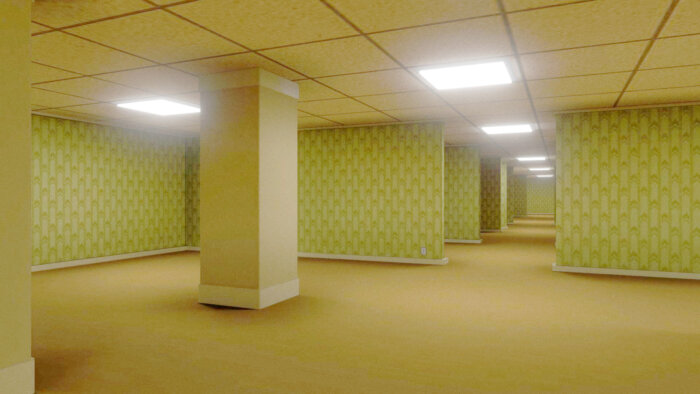
It was out of this context that the idea for “The Backrooms” emerged, first as “creepypasta” — internet slang for a spooky story that’s cut and pasted so many times that people lose sight of its original authorship. Like all good creepypastas, the post was thin in lore, leaving ample room for endless interpretation and reinterpretation. It appeared on 4chan’s /x/, the paranormal-positive board of the infamously anonymous internet hate machine, and was conjured in response to a prompt asking for spaces that looked wrong. One anon posted a picture of an eerily empty, yellowed office space, alongside the text:
If you’re not careful and you Noclip out of reality in the wrong areas, you’ll end up in the Backrooms, where it’s nothing but the stink of old moist carpet, the madness of mono-yellow, the endless background noise of fluorescent lights at maximum hum-buzz, and the approximately six hundred million square miles of randomly segmented empty rooms to be trapped in.
God save you if you hear something wandering around nearby, because it sure as hell has heard you.
That term, “noclip,” is meaningful here. It’s video game-speak for falling through what appears to be a stable in-game object — a failure of digital collision detection. This kind of slippage combines esoteric notions about the flimsiness of reality with gaming logic, not unlike the notion that real-life people are non-player characters (NPCs) or the hypothesis that we live in a computer simulation. Like the simulation hypothesis, noclipping presents the world as an imperfect construct built by unseen programmers and suggests a humanity at the brink of becoming digital objects themselves.
For a while, “The Backrooms” was a crowdsourced effort, confined purely to niche corners of the internet. Its fans created level after level of wiki-madness, posting thousands of eerie officescapes one might accidentally noclip into. Then it got bigger: In 2022, then-17-year-old Kane Parsons (who’s also director of the A24 film) created an eponymous web series, supplementing the aesthetic with deep lore. Parsons’ creation, which he designed with a 3D modeling software often used for game development, soon went massively viral, with over 190 million views to date.
In these new tales, offices become inescapable traps — long winding corridors with no way out.
In the nine-minute, 14-second pilot, Parsons carries his camera in a game-like first-person perspective. He plays the role of a 1991 indie filmmaker who suddenly falls downward into duplications of the same interior, navigating an eerie, brightly lit, otherwise empty office of the “Async Research Institute.” After a brief exploration, he is stalked by a chimeric creature (a “lifeform”) composed of wires and unknown organic materials that looks more machine than human. As with all found-footage horror, it doesn’t end well for anyone.
Thanks in large part to “The Backrooms,” media scholars have begun to grapple more seriously with the sudden popularity of liminal aesthetics in online folklore.
Bradley Earl Wiggins argues the genre taps into a “nostalgia” that offers a “critique of consumerist society during perceived notions of late capitalism” through its hyperreal game-like visuals — reproductions of things that never physically existed. Likewise, Elinor Dolliver characterizes the appeal as a new spin on storytelling in the analog-horror style, which gives the impression of folklore without any connection to actual history. I agree with both takes, but I would further suggest the rise of liminality evinces the resonance of a new media genre altogether — one which I’d call the Institutional Gothic.
To understand this shift, we need to wind back the clock a couple of hundred years.
Horace Walpole’s “The Castle of Otranto” (1764), a tale of crumbling aristocracies, secrets, revenge, murder, and hauntings, is widely regarded as the original Gothic novel. The genre exerted its influence throughout the 19th century, with what Fred Botting refers to as the “return of the pasts on the present”— the sins of older generations bearing upon the young. Its settings were necessarily both familiar and mysterious, often situated in dramatic, desolate landscapes. The gothic was marked by duplicitous, monstrous antagonists, terrified heroines, fragmented narratives, and the supernatural. Its particularities changed with new locales and time periods, but at their thematic root, they’ve always been negotiations of cultural and social mores, reminding us that our present can never escape the ghosts of our past.
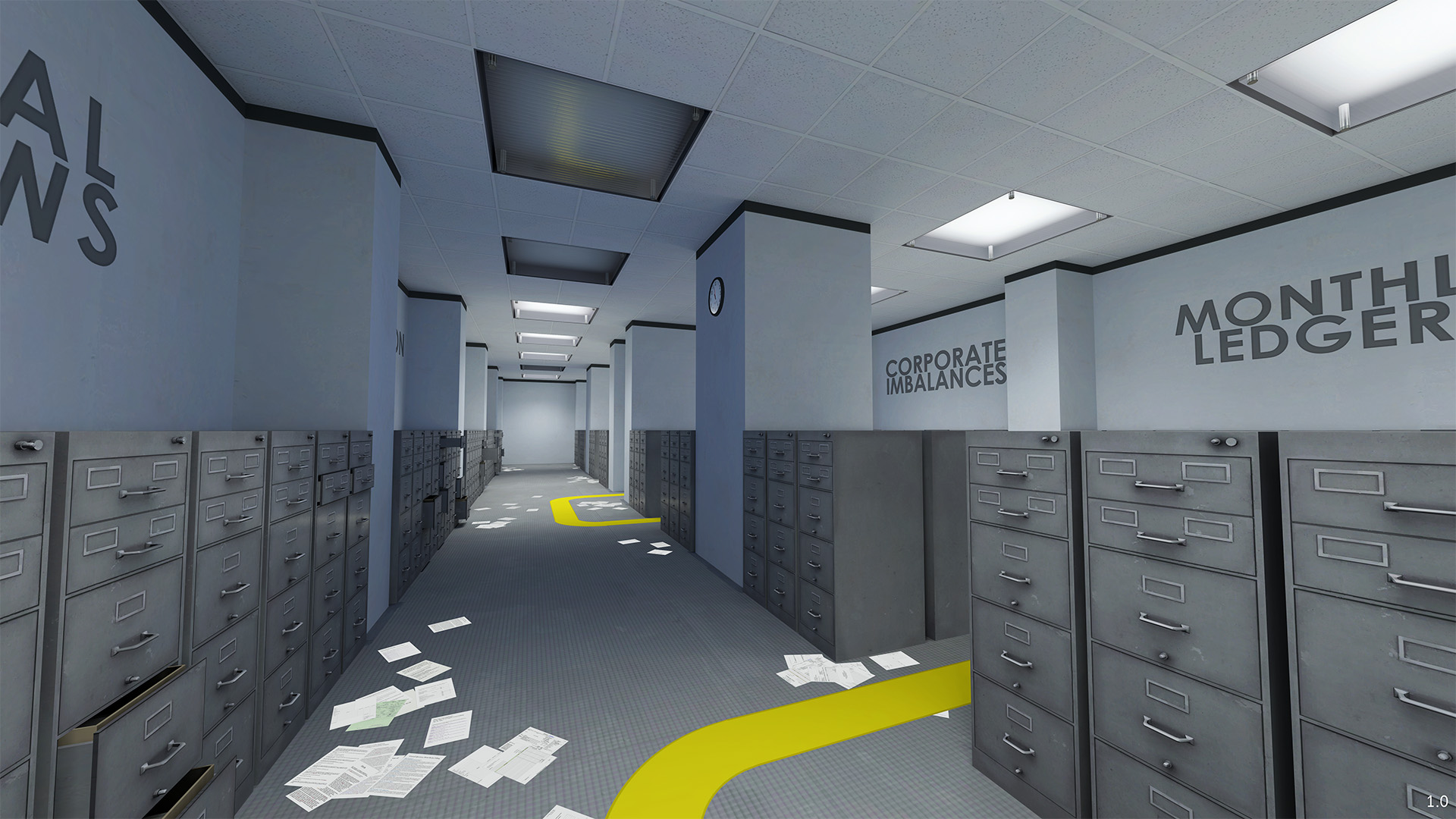
Which brings us to the Institutional Gothic. Like the traditional Gothic, the Institutional Gothic involves uncanny spaces, malevolent forces, and overwhelming discomfort related to spatiality and power. But where the traditional Gothic is dark and looming with ornate architecture, the Institutional Gothic occurs in winding or otherwise empty office spaces, consumed by machine-made mundanity and the unforgiving gaze of noisy overhead fluorescent lighting. The antagonists, once bloodthirsty lords, are instead soulless corporations. The protagonists, once women at the mercy of those lords, are now often white men, wandering fearfully or uncomfortably through those catacombs.
Taken together, the Institutional Gothic transforms a genre once fueled by phantasmal terror into the familiar, worldly dread of workplace alienation.
There are many examples of this beyond “The Backrooms.” The video game “The Stanley Parable” and the AppleTV series “Severance” (filmed at the semi-abandoned Bell Works complex in New Jersey) share the same aesthetic. Aspects of Institutional Gothic have also crept into real life in recent years, with the emptied fiefdoms of our post-pandemic workplaces. The aesthetic has apparently even found its way into our subconscious: Thousands of people online last year shared the experience of having the same lucid dream — walking through empty food courts and stairs to nowhere in a giant abandoned “Mall World.”
“The Backrooms” reminds us that we have no choice but to negotiate with the monsters and sins of our past.
When it comes to “The Backrooms,” though, we find all the hallmarks of the Institutional Gothic: the labyrinthine hallways, bright lights, the bland “madness of mono-yellow,” and a supernatural subtext built out of the mythologies of corporate and government experimental woo-woo. It is no coincidence that “The Backrooms” is set mostly in the ’80s and ’90s, a time of great prosperity for the American middle class. It was the heyday of cubicles, where infinitely reusable office spaces, despite the booms and busts of modern capitalism, seemed as though they’d be useful forever. By the early 2000s, the cubicles were mostly eclipsed by panopticon-friendly open floor plans. And today, with many industries scaling back, our old institutions are increasingly emptied out.
If traditional Gothic is about the sins of the past revisiting the present, then the Institutional Gothic echoes that trope by focusing not on the class-based horrors of 200 years ago, but on the (still class-based) corporate choices made within the 20th century. The middle class has been alienated and abandoned by Corporate America. In these new tales, offices become inescapable traps — long winding corridors with no way out.
Of course, monsters remain at the heart of the Institutional Gothic, too. The “lifeform” of “The Backrooms” was never the real monster, as was the case with Mary Shelley’s Gothic horror “Frankenstein.” Rather, the monster was always the creator, which, in the case of the Institutional Gothic, is the efficiency-seeking corporation. From environmental destruction to indifference to human harm, our 20th-century oligopolies paved the path to where we are now. Like a hydra, they cannot be killed; they just re-form under a new head.
In one of the most suspenseful moments from “The Backrooms,” we see a group of men in hazmat suits holding a red tether line as they explore the alien office environment. It’s odd watching a cautious exploration into a space that would otherwise seem so familiar, the red line loudly pronouncing itself within all that mono-yellow.
But one can imagine a different version of this scene: a future humanity similarly excavating remains of corporate hallways that have since crumbled, wondering what life could have been like at the turn of the 20th century. What might our strange office spaces look like to the humans of the 2100s? What might they eventually look like to Gen Z and Gen Alpha, who may only know these environments through the ominous “Backrooms” or the goofy hijinks of “The Office”?
As we reconcile with our lost spaces and our offices give way to new “lifeforms,” such as billion-dollar data centers for AI and cloud computing, liminality will continue to define this threshold moment between physicality and digitality. “The Backrooms” — in all its iterations — reminds us that we have no choice but to negotiate with the monsters and sins of our past as we noclip into an unknown future.
Shira Chess is Associate Professor of Entertainment and Media Studies at the University of Georgia. She is the author of “Play Like a Feminist,” “Ready Player Two,” and “The Unseen Internet.” You can find more of her work on her Substack.