Is Creativity a Young Person’s Game?
There’s an unspoken assumption, particularly in America, that youth and creativity tend to go hand in hand. It’s no surprise: Many of the artistic greats, from Jack Kerouac and Bob Dylan to Zadie Smith and Taylor Swift, found immense success when they were young. The fastest-growing startups — Meta, Snapchat, Airbnb, and so on — were founded by twentysomethings, some of whom never graduated from college. A quote frequently attributed to Albert Einstein holds that scientists who have not made a great contribution to their fields before the age of 30 will never do so in their lifetimes. As one of my chemist colleagues, at 55, told me, “Science is a young man’s game.”
But can we generalize from these anecdotes? Can we really conclude that young people are more creative than their older counterparts? To answer this question, we need to determine when people are at their creative peak, and to do that, we need to delve into the science of creativity.
In my book with Danah Henriksen, “Explaining Creativity,” I touch upon studies of thousands of creators, from their 20s to the end of their lives, demonstrating that they generate their best work at the same time they’re putting the most work out into the world. This is particularly true of scientists, whose creative contributions are well documented because everything they do is quantified through citations, publications, books, awards, and patents.
What age, you might wonder, are scientists likely to be when the Nobel committee comes calling? Would you bet on the young striver or the seasoned expert? The answer, interestingly, is neither. The most creative people are smack in the middle of their careers — neither in their 20s nor nearing retirement. If we were to visualize this finding, we’d see that creativity is an inverted-U function of career age, or the length of time the individual has been working in their field.
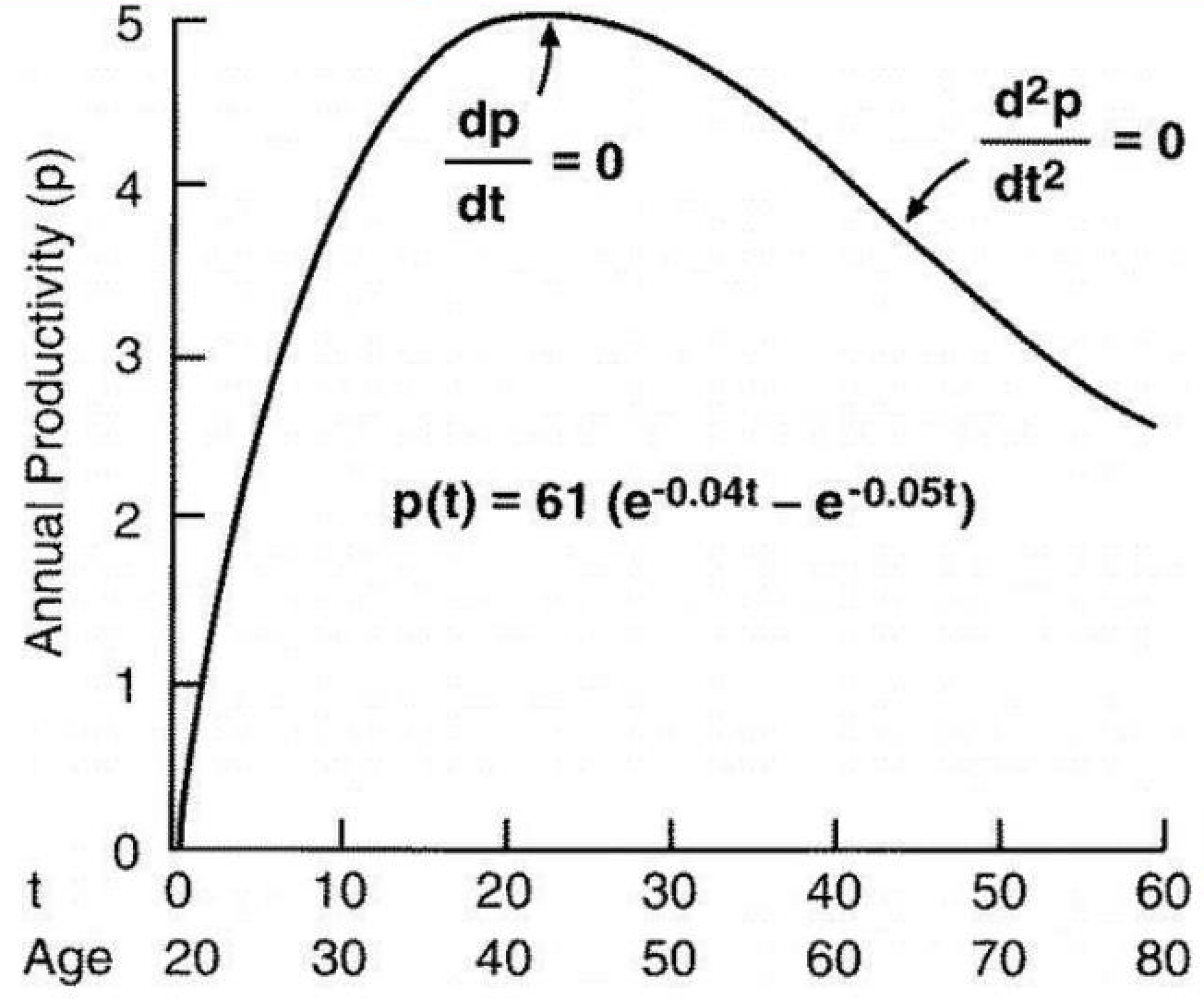
In other words, as the years go by, productivity increases until it peaks. Then creativity starts to drop, and it continues to decline.
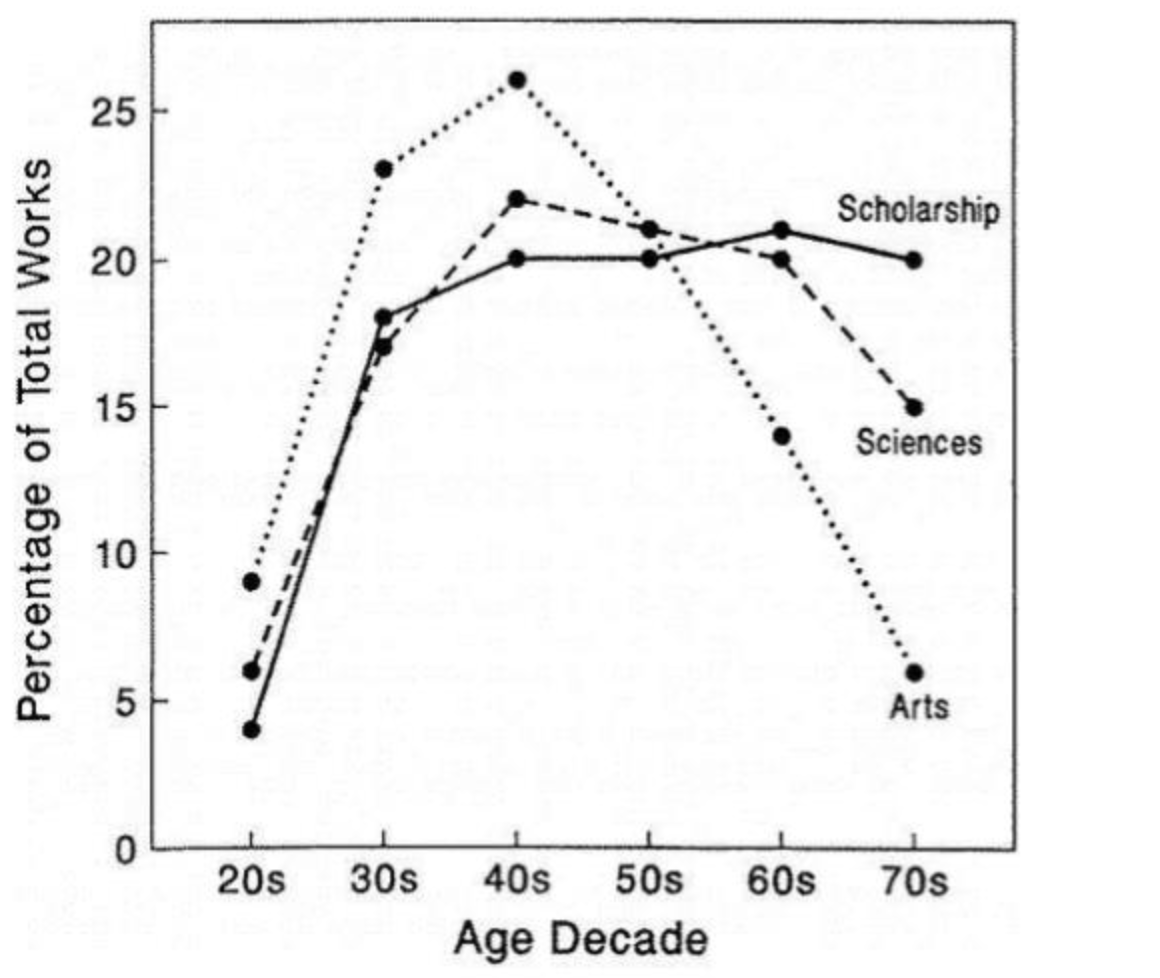
The story is, of course, different depending on the type of work you do. Physicists, writers, and painters peak in their 20s or 30s, biologists and social scientists peak in their 40s, and writers and philosophers can maintain a steady output through to retirement. This broadly aligns with a 1966 study showing that scientists and artists peak earlier than scholars such as historians and psychologists.
I also want to stress again that the research shows creators have their most important, groundbreaking ideas in the same year they’re most prolific. If you’re a serial inventor, the patent that makes you millions is likely to be from the same year that you filed the most patents. If you’re a painter, then your most famous painting will likely be in the same year that you made the most paintings. The key to successful creativity is productivity; quantity leads to quality.
You might be wondering what these insights mean for your own creative output, whether you’re a writer, coder, sculptor, engineer, or anything else. You’re right to wonder, especially in a society where all manner of things are competing for your attention, making sustained focus — a prerequisite of creativity — increasingly hard to hone. So, I’ve compiled below a list of several nuggets of wisdom that might help maximize your creative output. It goes without saying that these are easier said than done:
- Work hard and finish projects. The aim should always be to put your creations into the world.
- Don’t spend all of your time on just one idea, no matter how great you think it is. Spread your energy around. Place multiple bets.
- Some creative professions — and some types of work — peak earlier than others. Consider switching to a different path in your 30s or 40s to catch multiple peaks.
- If you want quick success, choose professions that peak early: math, science, computers, and engineering. But if you want a sustained creative life, look more broadly.
Applying these principles in the real world can certainly be challenging. For instance, if you’re in high school or college, what should you major in? Liberal arts colleges have been saying for years, “We’re not educating you for your first job; we’re educating you for your entire career.” That kind of holistic approach to education is great. But in such a volatile labor market as America’s, you do still need that first job. So maybe consider double-majoring in an early-career field (math, engineering) and a later-career field (literature, history, philosophy).
If you’re mid-career, you’re at your peak, so make good use of the resources, the network, and the reputation that you have already built for yourself. By now, you should have the foundation to do your best work. If you’re nearing retirement, you simply can’t coast. You must work just as hard as you did in your 20s, which might be painful at an older age. But if you put in the work, your experience and wisdom will pay off greatly.
One more thing: The beauty of creativity is that it’s often collaborative. This means that you can expand your creative potential by collaborating across age groups. So, consider pairing up with someone who is considerably older or younger than you. This might feel counterintuitive: If you’re senior and experienced, you probably have a fancier title, you make more money than your younger colleagues, and you may wonder: What can that recent college graduate with little to no professional experience teach me? But trust me, that college graduate is thinking that much of your so-called expertise is outmoded and irrelevant.
This divide is difficult to bridge in the workplace. But throughout human history, it has been done repeatedly with great success: Niels Bohr and Werner Heisenberg were over two decades apart in age when they together fundamentally reshaped quantum mechanics. Larry Page and Eric Schmidt had a 20-year age gap when they founded Google. Leonard Bernstein, as a middle-aged musician, composed works often directly inspired by those of his younger students. If people of different age groups can learn to combine their respective strengths, collaboration across decades of life experience is a surefire path to greater creativity.
Keith Sawyer is one of the world’s leading researchers on creativity. He has published 20 books, including “Group Genius,” “Zig Zag,” and, most recently, “Learning to See.” Sawyer is the Morgan Distinguished Professor in Educational Innovations at the University of North Carolina at Chapel Hill. He’s the host of the podcast “The Science of Creativity.” A version of this article first appeared on Sawyer’s Substack.